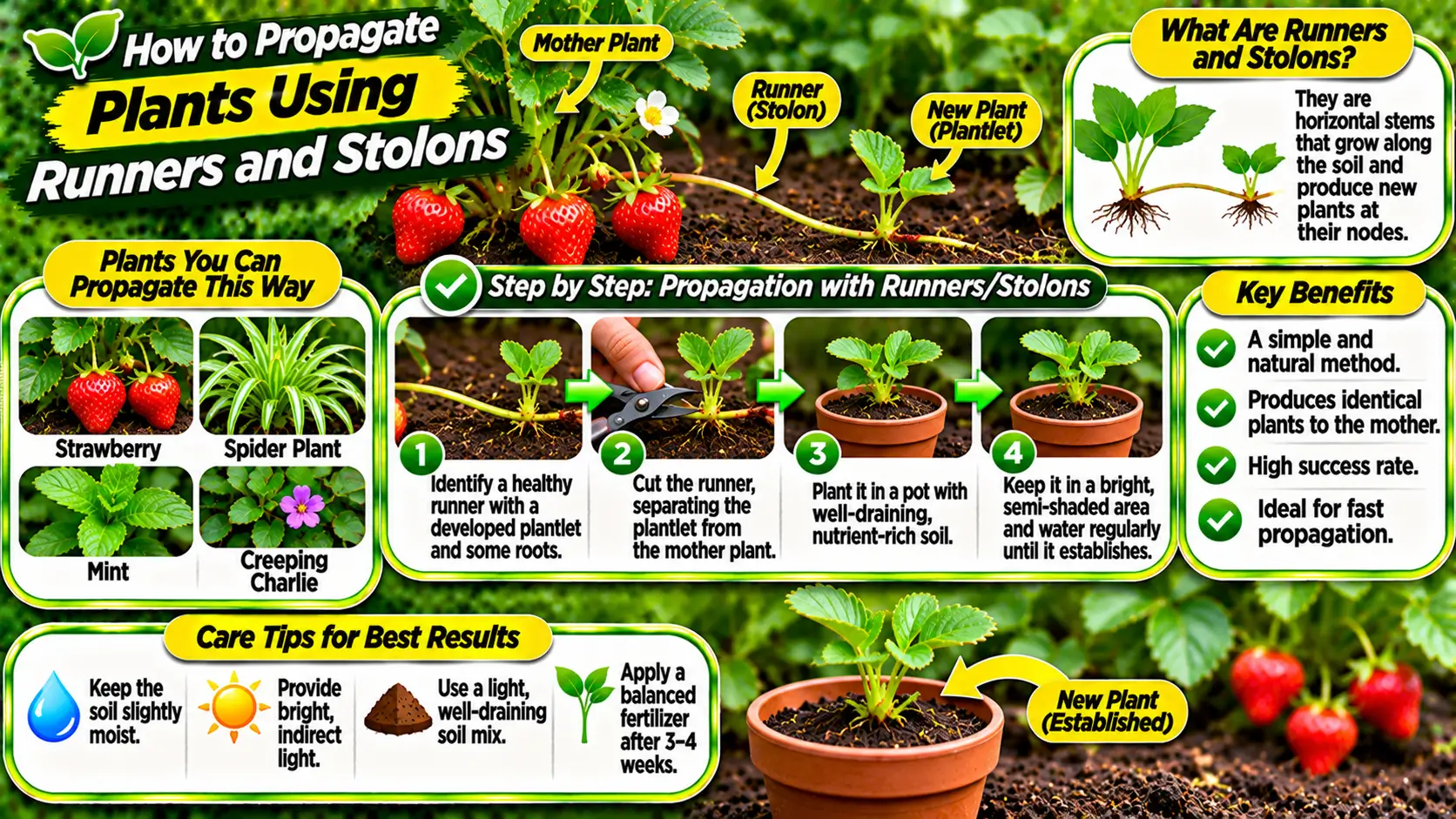
Runner, stolon, and rhizome are different structures
Gardeners sometimes use runner and stolon as synonyms, but horticultural references may distinguish them by form and growth habit. A stolon is generally a horizontal stem that can root at nodes; a runner is often a slender extension that produces a plantlet at a node or tip. A rhizome, by contrast, is usually an underground or soil-level stem with buds and scale leaves. Identify the structure before cutting because a plantlet on a runner is managed differently from a division of an underground rhizome.
When a plantlet is still attached, set its node against moist growing medium and secure it gently without burying its crown. Keep the runner connected until roots and new growth indicate that the plantlet can support itself. If the species roots readily after detachment, use the recommended rooting medium and humidity conditions rather than assuming the same approach works for every ground cover or hanging plant.
Managing strawberry runners versus fruit production
In strawberries, runner production can compete with the plant’s allocation of resources to fruiting, and the preferred balance depends on the production system and cultivar. A home gardener multiplying plants may retain selected daughter plants, while a planting managed primarily for harvest may remove excess runners according to the crop system. Do not remove every runner automatically or allow every runner to root without considering spacing, airflow, and the purpose of the bed.
| Garden objective | Runner strategy | Why |
|---|---|---|
| Multiply plants for a new bed | Root a planned number of vigorous daughter plants | Creates replacements while limiting overcrowding |
| Maintain a tidy container | Remove unwanted runners or root one in a nearby pot | Prevents tangling and competition |
| Prioritize fruit production | Follow the cultivar and production-system guidance for runner removal | Balances vegetative growth with the crop objective |
| Control a spreading ground cover | Confine rooting nodes and remove escapes | Limits spread beyond the intended area |
Virginia Tech Extension distinguishes stolons and runners by their growth pattern and explains that plantlets may be rooted while attached or in a rooting medium. Mississippi State University Extension also identifies stolons as growth extensions, such as those produced by strawberries. Local invasive-plant guidance should be checked before introducing vigorous spreaders outdoors.
Related Gardening Guides
Explore these related guides for more practical ideas and planning advice:
- How to Propagate Plants from Basal Offsets and Pups
- How to Propagate Plants from Suckers: Identification, Removal, and Care
- How to Propagate Plants from Corms: Dividing, Planting, and Aftercare
Runners, also called stolons in many gardening contexts, are horizontal stems that grow away from a parent plant. At nodes along these stems, some species produce roots and small plantlets. When a plantlet becomes established, it can often be separated and grown independently. Strawberries are a familiar example, but several ground covers and ornamental plants use similar growth habits. The technique is usually straightforward, although the timing and care needed depend on the plant.
Table of Contents
- Identifying a suitable plantlet
- Understanding the connection to the parent
- Preparing a pot or planting site
- Encouraging the plantlet to root
- When to separate the new plant
- Potting and aftercare
- Managing multiple runners
- Common mistakes
- Keeping propagation healthy
- Using runners in garden design
- A simple repeatable method
- Runner, stolon, and rhizome are different structures
- Managing strawberry runners versus fruit production
- Frequently Asked Questions
Identifying a suitable plantlet
Look for a small cluster of leaves growing at a node on a runner. A plantlet may already have short roots or may need to be encouraged to root where it touches the growing medium. Choose a vigorous plantlet with healthy leaves and no visible pests or disease. Avoid selecting one that is tiny, yellowing, or attached to a weak parent. If the species produces several plantlets, choose the strongest and avoid overloading the parent with too many developing offshoots.
Understanding the connection to the parent
A runner supplies water and nutrients from the parent plant while the new plantlet develops. This connection is helpful because it allows the young plant to establish before separation. Cutting the runner too early can leave a plantlet with too little root capacity to support itself. On the other hand, leaving every plantlet attached indefinitely can create crowded growth and reduce airflow. The goal is to allow enough rooting and leaf development before separating the new plant.
Preparing a pot or planting site
Use a small pot with drainage holes and a suitable potting mix, or prepare a well-drained garden spot if the plant is intended for a bed. Moisten the medium before positioning the plantlet. Place the pot close enough to the parent that the runner can reach without being stretched or kinked. For garden rooting, loosen the soil and remove weeds around the node. A clean, prepared site makes it easier to keep track of the new plant.
Encouraging the plantlet to root
Position the node or base of the plantlet against the moist medium and secure it gently with a U-shaped pin or another safe support if needed. Keep the leaves above the surface and avoid burying the crown. Maintain even moisture while roots develop, but do not keep the pot waterlogged. The parent runner can remain attached during this stage. Check occasionally for resistance to a very gentle touch or visible roots at drainage holes, without repeatedly disturbing the plantlet.
When to separate the new plant
Separate the plantlet once it has a healthy root system and several leaves capable of supporting growth. The exact time varies by species and growing conditions. Use clean scissors to cut the runner between the parent and plantlet, leaving enough stem near the new plant to avoid damaging its crown. If roots are sparse, wait longer when the parent is healthy and the growing season allows. Do not pull the plantlet free by force.
Potting and aftercare
If the plantlet has rooted in a pot, check that the root ball holds together before moving it. If it rooted in a garden bed, lift it with a small amount of surrounding soil. Place it at the same depth in its final container or planting area, firm the medium gently, and water it in. Keep it protected from harsh afternoon sun and drying wind while it adjusts. Avoid heavy fertilizer immediately after separation.
Managing multiple runners
Some plants produce more runners than are useful for the available space. Select a limited number of strong plantlets and remove unwanted runners with clean tools. In a fruiting crop, the balance between runner production and fruit production may matter, so follow crop-specific guidance. Crowded plantlets can compete for light and air, making them more vulnerable to pests and disease. A planned arrangement helps maintain access for watering, harvesting, and inspection.
Common mistakes
Common errors include separating plantlets before they have roots, burying the crown, allowing the rooting medium to dry completely, or keeping it saturated. A runner that is stretched tightly between pots can break, while a loose plantlet may shift and lose contact with the medium. Poor labeling can make it difficult to identify cultivars. Secure the plantlet gently, check moisture regularly, and give the new plant time to establish before moving it again.
Keeping propagation healthy
Inspect both parent and plantlets for aphids, mites, fungal symptoms, or other problems. Do not propagate from a plant with unexplained decline or serious disease. Remove dead leaves and keep the area tidy without stripping healthy foliage. Clean tools between plants and avoid sharing contaminated potting mix. If the parent is in a container, make sure it has enough room and suitable care to support continued growth.
Using runners in garden design
Runner-forming plants can be useful for filling gaps, covering soil, or creating a continuous planting. Their spreading habit can also become invasive in some settings, so check local guidance before planting them outdoors. Keep vigorous species within defined boundaries and remove unwanted plantlets before they spread into paths or neighboring beds. A controlled propagation plan lets gardeners multiply useful plants without allowing them to dominate the space.
A simple repeatable method
The process is to select a healthy plantlet, prepare a pot or soil site, root the node while it remains attached to the parent, and separate it only after roots develop. Provide gentle aftercare and monitor the young plant for new growth. This method uses the plant’s natural growth habit and usually requires little specialized equipment. With appropriate timing and spacing, runners can provide a steady supply of new plants while keeping the parent plant healthy.
Build a simple record for each propagation attempt. Note the plant name, parent plant, date, method, growing medium, light conditions, and watering pattern. If a cutting or young plant fails, these details can help reveal whether the issue was timing, material quality, moisture, temperature, or handling. Records are especially useful when propagating several varieties that look similar.
Keep propagation material separate from plants that show unexplained decline. Pests and pathogens can move on leaves, stems, roots, tools, and containers. Inspect the parent before taking material, clean equipment between plants, and discard diseased pieces promptly. A clean starting point cannot guarantee success, but it removes several avoidable sources of failure.
Resist the temptation to speed up every stage with extra fertilizer or concentrated products. New roots and shoots are delicate, and high nutrient levels can damage them or encourage weak growth. Use a medium appropriate for the plant and provide the light, moisture, and temperature it needs. Change one condition at a time if you need to troubleshoot, so you can understand what actually helped.
Do not judge a new plant only by the appearance of its first leaves. It may need time to build a root system before producing vigorous top growth. Keep the medium appropriately moist, provide suitable light, and avoid repeated repotting. If the plant remains firm and gradually develops new growth, it may simply be establishing at its own pace.
Propagation is also a way to learn the growth habit of a plant. Observe where roots form, how new shoots emerge, and which conditions encourage healthy development. The method that works for one species may not work for another, even when the plants look similar. Use reliable species-specific instructions and treat each new batch as a small, carefully observed trial.
Runner propagation checklist
| Step | What to look for | Action |
|---|---|---|
| Plantlet selection | Healthy leaves and a developed growing point | Choose a vigorous plantlet, not a damaged one |
| Parent connection | Runner remains attached and may still supply resources | Root the plantlet while attached when practical |
| Root development | Roots visible in or near the growing medium | Wait for adequate roots before severing |
| Separation | Plantlet is stable and independently viable | Cut the runner with clean tools |
| Aftercare | New roots are vulnerable to drying and saturation | Maintain suitable moisture and sheltered light |
| Runner management | Excess runners crowd the parent or bed | Keep selected plantlets and remove unwanted growth |
For additional guidance, consult University of Florida IFAS guide to plant propagation techniques.
Explore these related propagation guides:
Explore more related propagation methods:
Runner, stolon, and rhizome are different structures
Gardeners sometimes use runner and stolon as synonyms, but horticultural references may distinguish them by form and growth habit. A stolon is generally a horizontal stem that can root at nodes; a runner is often a slender extension that produces a plantlet at a node or tip. A rhizome, by contrast, is usually an underground or soil-level stem with buds and scale leaves. Identify the structure before cutting because a plantlet on a runner is managed differently from a division of an underground rhizome.
When a plantlet is still attached, set its node against moist growing medium and secure it gently without burying its crown. Keep the runner connected until roots and new growth indicate that the plantlet can support itself. If the species roots readily after detachment, use the recommended rooting medium and humidity conditions rather than assuming the same approach works for every ground cover or hanging plant.
Managing strawberry runners versus fruit production
In strawberries, runner production can compete with the plant’s allocation of resources to fruiting, and the preferred balance depends on the production system and cultivar. A home gardener multiplying plants may retain selected daughter plants, while a planting managed primarily for harvest may remove excess runners according to the crop system. Do not remove every runner automatically or allow every runner to root without considering spacing, airflow, and the purpose of the bed.
| Garden objective | Runner strategy | Why |
|---|---|---|
| Multiply plants for a new bed | Root a planned number of vigorous daughter plants | Creates replacements while limiting overcrowding |
| Maintain a tidy container | Remove unwanted runners or root one in a nearby pot | Prevents tangling and competition |
| Prioritize fruit production | Follow the cultivar and production-system guidance for runner removal | Balances vegetative growth with the crop objective |
| Control a spreading ground cover | Confine rooting nodes and remove escapes | Limits spread beyond the intended area |
Virginia Tech Extension distinguishes stolons and runners by their growth pattern and explains that plantlets may be rooted while attached or in a rooting medium. Mississippi State University Extension also identifies stolons as growth extensions, such as those produced by strawberries. Local invasive-plant guidance should be checked before introducing vigorous spreaders outdoors.
Related Gardening Guides
Explore these related guides for more practical ideas and planning advice:
- How to Propagate Plants from Basal Offsets and Pups
- How to Propagate Plants from Suckers: Identification, Removal, and Care
- How to Propagate Plants from Corms: Dividing, Planting, and Aftercare
Frequently Asked Questions
Are runners and stolons the same thing?
The terms are often used for horizontal stems that produce new plantlets, although botanical usage can vary. Identify the structure and growth habit of the species before deciding how to propagate it.
When should I detach a plantlet from its runner?
Wait until the plantlet is well developed and, where possible, has formed roots. Some can be rooted while still attached to the parent, which reduces stress during establishment.
Should I remove strawberry runners to get more fruit?
It depends on the goal. Removing some runners can direct more resources toward fruit production, while allowing selected runners to root helps create new plants. Follow the needs of the strawberry type and growing system.
Can every plant that produces a runner be propagated this way?
No. Some runners form viable plantlets, while other horizontal stems have different functions. Confirm that the plant naturally produces rooted offsets before cutting or separating it.
4 thoughts on “How to Propagate Plants Using Runners and Stolons”