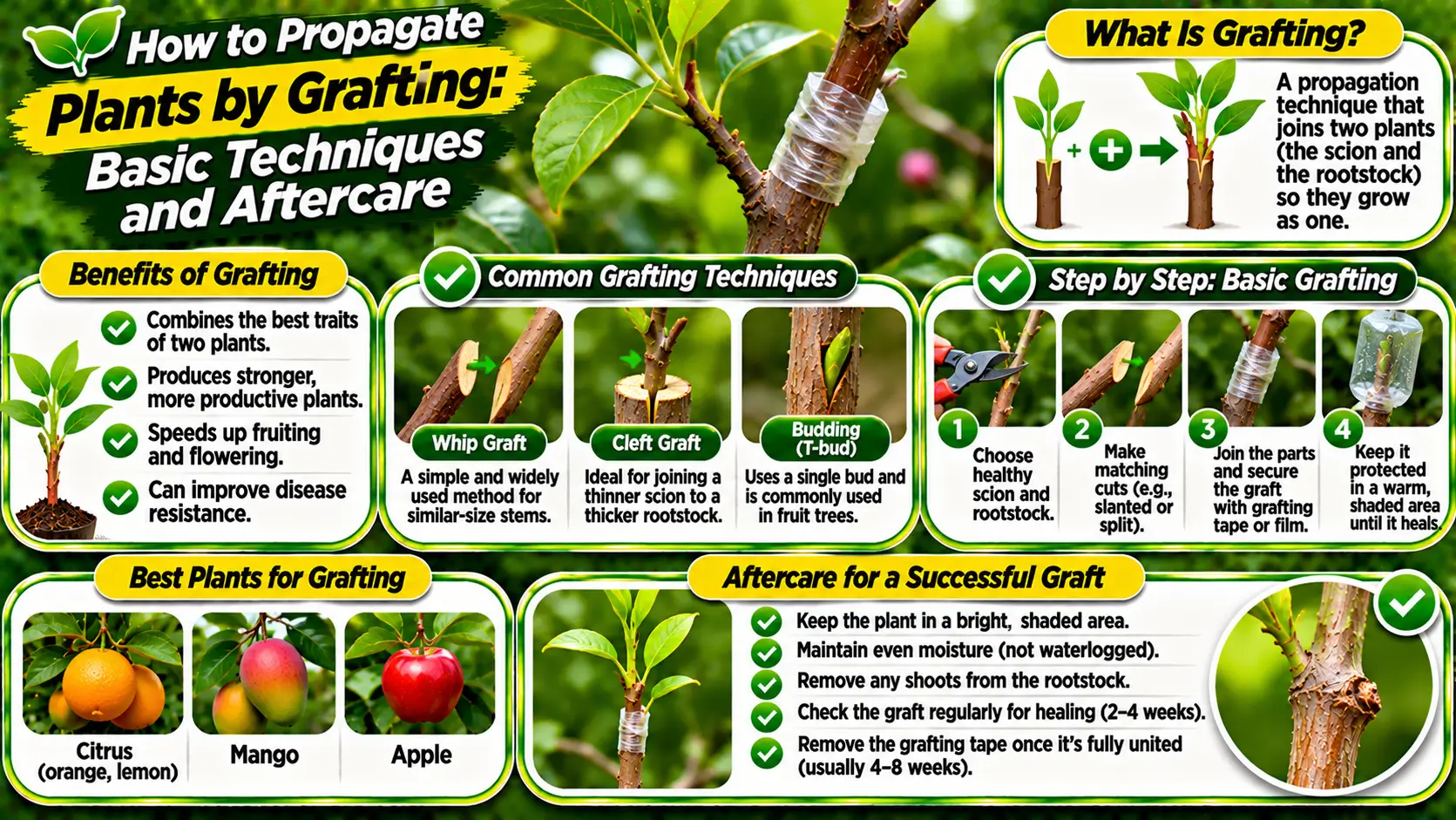
Grafting joins a piece of one plant, called the scion, to another plant that supplies the root system, called the rootstock. If the tissues unite successfully, the scion can grow using the rootstock’s roots. Gardeners and growers use grafting to combine desirable fruit, flower, or growth characteristics with root systems selected for vigor, soil adaptation, or disease tolerance. Grafting is different from ordinary rooting because the scion does not usually form an independent root system.
Table of Contents
- Choosing compatible plants
- Understanding the graft union
- Selecting the grafting method
- Preparing tools and materials
- Preparing the scion
- Making and aligning the cuts
- Securing and protecting the union
- Aftercare and growing conditions
- Recognizing success or failure
- Common grafting mistakes
- Safety and responsible practice
- When grafting is the right choice
- Compatibility is the first grafting test
- Graft union troubleshooting
- Frequently Asked Questions
Choosing compatible plants
The scion and rootstock generally need to be botanically compatible, often within the same species or closely related groups. Two unrelated plants will not reliably unite simply because their cut surfaces touch. Research the exact cultivar and rootstock combination before starting. Fruit trees, roses, and some ornamental plants have established grafting practices, but compatibility varies. Use healthy, correctly identified material from reliable sources and avoid grafting plants that are diseased or under severe stress.
Understanding the graft union
Successful grafting depends on close contact between the living cambium layers of the scion and rootstock. These thin tissues are responsible for growth and help form the connection between the two pieces. The cut surfaces must fit securely and remain aligned while healing occurs. A graft may look joined on the outside before the internal connection is strong enough to support vigorous growth. Protecting the union from movement and drying is therefore essential.
Selecting the grafting method
Several methods exist, including whip-and-tongue, cleft, side-veneer, and budding. The best choice depends on plant species, stem diameter, season, and the experience of the grower. A simple matching-diameter graft may be suitable for young woody stems, while other methods are used for larger rootstocks or particular crops. Do not choose a technique based only on a picture; consult instructions designed for the plant and rootstock combination.
Preparing tools and materials
Use a sharp grafting knife or suitable blade, clean pruning shears, grafting tape, and labels. A dull blade crushes tissue and creates uneven surfaces that are difficult to align. Clean tools before use and between plants to reduce the chance of transmitting disease. Prepare the scion and rootstock before making cuts, and keep materials shaded and protected from drying. If the plant produces irritating sap or has thorns, use appropriate protective equipment.
Preparing the scion
A scion is usually selected from healthy growth of the desired cultivar. It should be mature enough for the chosen technique and free from pests, disease, and physical damage. The required bud number, length, and storage conditions vary by method and species. Keep scions labeled and prevent them from drying out before grafting. Do not use weak, dehydrated, or poorly stored material, because it is less likely to form a strong union.
Making and aligning the cuts
Make clean cuts using the angle and dimensions specified for the grafting method. Avoid touching the fresh cut surfaces more than necessary. Bring the scion and rootstock together so their cambium layers align along at least one side, especially when stem diameters differ. Secure the pieces firmly enough to prevent movement without crushing the tissues. The exact cut shape is technique-specific, so practice on spare material before working on a valuable plant.
Securing and protecting the union
Use grafting tape or another suitable material to hold the union in place and reduce moisture loss. Seal exposed surfaces when recommended for the method and species. Do not wrap so tightly that the material constricts growth as the graft develops. Some wraps degrade over time, while others must be removed or loosened. Follow the chosen method’s instructions and inspect the union periodically without repeatedly disturbing it.
Aftercare and growing conditions
Keep the grafted plant in conditions suitable for the species, avoiding extremes of heat, cold, wind, or drought. Support the plant so movement does not break the union. Remove shoots that emerge from the rootstock below the graft when appropriate, because they can compete with the scion. Maintain suitable moisture without waterlogging the roots. Avoid heavy fertilization immediately after grafting; stable conditions allow the union to develop.
Recognizing success or failure
Bud swelling, leaf development, and continued scion growth can indicate that a graft is taking, but early growth alone does not prove the union is strong. Watch for shriveling, blackening, separation, or dieback. A graft that fails may have been incompatible, poorly aligned, allowed to dry, moved during healing, or made at an unsuitable time. Record the method and conditions so you can improve future attempts rather than repeating the same mistake.
Common grafting mistakes
Common problems include using incompatible plants, taking unhealthy scions, working with dull tools, allowing cuts to dry, misaligning cambium layers, and failing to secure the union. Another error is leaving rootstock shoots to grow unchecked or forgetting to remove constricting tape. Grafting is a skill that improves with practice. Begin with a common, well-documented plant combination and use a small number of attempts before applying the technique to valuable specimens.
Safety and responsible practice
Use sharp blades carefully, cut away from your body, and store tools safely when not in use. Disinfect equipment according to suitable horticultural guidance, particularly when moving between plants. Follow local rules for plant movement and propagation, since some cultivars may be protected by plant variety rights or other restrictions. Do not exchange potentially infected plant material. When in doubt, obtain scions and rootstocks from reputable nurseries.
When grafting is the right choice
Grafting is useful when a grower wants to combine traits that cannot be reliably achieved through seed or ordinary cuttings. It requires compatible material, precise technique, and attentive aftercare, so it is not always the easiest propagation method for beginners. Learn the requirements of the species, practice clean cuts, and protect the union while it heals. With suitable combinations and careful handling, grafting can produce plants with selected characteristics and dependable root systems.
Build a simple record for each propagation attempt. Note the plant name, parent plant, date, method, growing medium, light conditions, and watering pattern. If a cutting or young plant fails, these details can help reveal whether the issue was timing, material quality, moisture, temperature, or handling. Records are especially useful when propagating several varieties that look similar.
Keep propagation material separate from plants that show unexplained decline. Pests and pathogens can move on leaves, stems, roots, tools, and containers. Inspect the parent before taking material, clean equipment between plants, and discard diseased pieces promptly. A clean starting point cannot guarantee success, but it removes several avoidable sources of failure.
Resist the temptation to speed up every stage with extra fertilizer or concentrated products. New roots and shoots are delicate, and high nutrient levels can damage them or encourage weak growth. Use a medium appropriate for the plant and provide the light, moisture, and temperature it needs. Change one condition at a time if you need to troubleshoot, so you can understand what actually helped.
Do not judge a new plant only by the appearance of its first leaves. It may need time to build a root system before producing vigorous top growth. Keep the medium appropriately moist, provide suitable light, and avoid repeated repotting. If the plant remains firm and gradually develops new growth, it may simply be establishing at its own pace.
Propagation is also a way to learn the growth habit of a plant. Observe where roots form, how new shoots emerge, and which conditions encourage healthy development. The method that works for one species may not work for another, even when the plants look similar. Use reliable species-specific instructions and treat each new batch as a small, carefully observed trial.
Grafting preparation and troubleshooting checklist
| Factor | Good practice | Common risk |
|---|---|---|
| Compatibility | Choose compatible scion and rootstock, usually within the same species or suitable related groups | Failed or weak union |
| Plant material | Use healthy, correctly matured scions and rootstocks | Desiccation, disease, or poor healing |
| Cut surfaces | Make clean cuts and align cambium layers | Insufficient tissue contact |
| Binding | Secure firmly without constricting growth | Movement or girdling |
| Aftercare | Protect from extremes and monitor moisture | Union drying or rotting |
| Follow-up | Watch for sustained scion growth and remove unwanted rootstock shoots | False confidence from initial bud swelling |
Review the University of Florida IFAS overview of plant propagation techniques for context on grafting and other methods; always follow species-specific grafting instructions.
Related propagation resources:
More related guides:
- How to Propagate Plants from Basal Offsets and Pups
- How to Propagate Plants from Suckers: Identification, Removal, and Care
Explore more related propagation methods:
Compatibility is the first grafting test
Good cutting technique cannot compensate for an incompatible scion and rootstock. The safest starting point is a proven combination within the same species or a documented compatible group for the crop. Some related plants can be grafted successfully, but botanical relatedness alone does not guarantee a durable union. Use a reputable crop-specific compatibility reference and healthy, correctly identified material. Avoid using scion wood or rootstock with unexplained decline, cankers, virus symptoms, or serious pest damage.
During assembly, align the cambium—the thin living growth layer beneath the bark—along at least one side of the cut. Matching the outside diameter perfectly is less important than ensuring cambial contact. Secure the joint so it cannot shift, and protect exposed cut surfaces from drying. The correct season, graft type, and scion maturity depend on the species and method; do not treat a cleft graft, whip-and-tongue graft, and budding as interchangeable procedures.
Graft union troubleshooting
| Observation | Possible explanation | What to review |
|---|---|---|
| Scion dries soon after grafting | Exposed tissue dried or contact was poor | Seal, wrapping, timing, and cambial alignment |
| Bud swells, then growth collapses | Stored reserves supported temporary growth without a lasting union | Union integrity and scion condition |
| Strong shoots emerge below the union | Rootstock is producing its own growth | Remove unwanted shoots without damaging the union |
| Union breaks cleanly later | Possible incompatibility or weak union | Documented compatibility and grafting technique |
| Uneven swelling or cracking | Possible poor alignment, constriction, or incompatibility | Wrapping tension and long-term union development |
Do not judge success from initial bud break alone. Monitor the union through subsequent growth and seasons. University of Maine Cooperative Extension identifies compatibility, correct physiological timing, cambial contact, and moisture protection as key conditions; University of Maryland Extension notes that incompatibility, technique, and environmental conditions can all contribute to failure.
Related Gardening Guides
Explore these related guides for more practical ideas and planning advice:
- How to Propagate Plants from Rhizomes: A Practical Step-by-Step Guide
- How to Propagate Plants from Corms: Dividing, Planting, and Aftercare
- How to Propagate Plants from Suckers: Identification, Removal, and Care
Frequently Asked Questions
Can any two plants be grafted together?
No. Successful grafting generally requires compatible plants, often within the same species or closely related groups. Compatibility depends on the plant and should be confirmed before attempting a graft.
What is the graft union?
The graft union is the point where the scion and rootstock join and form a functional connection. It needs close contact and stable alignment while the tissues heal.
When is the best time to graft a plant?
The best timing depends on the grafting method, species, and local climate. Many methods are timed around active cambial growth or dormancy, so follow a reliable species-specific guide.
How do I care for a plant after grafting?
Keep the graft stable, protect it from drying or movement, and monitor moisture and new growth. Remove shoots from the rootstock below the union when appropriate so they do not compete with the scion.
4 thoughts on “How to Propagate Plants by Grafting: Basic Techniques and Aftercare”