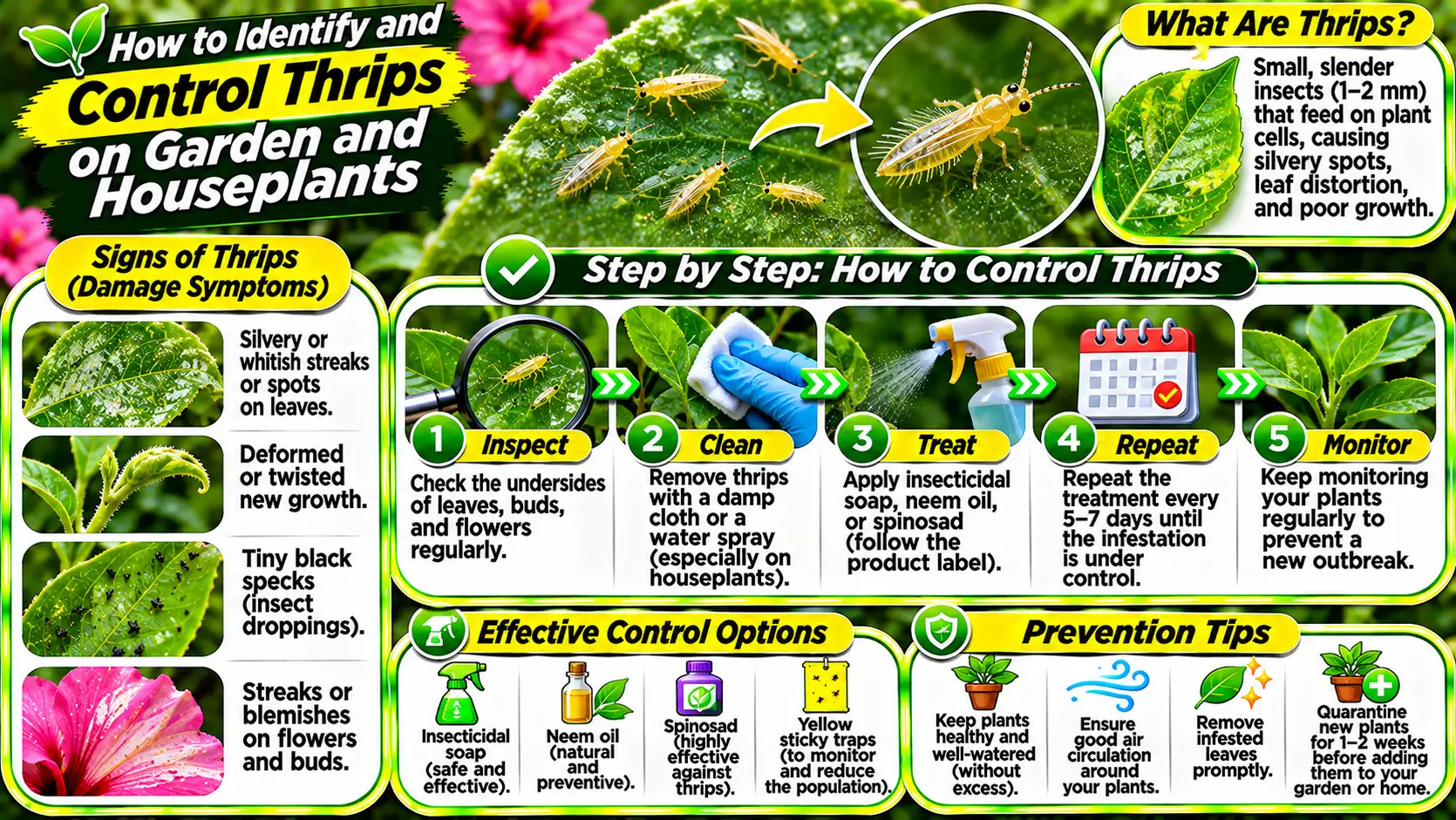
Thrips are slender, very small insects that feed by scraping plant surfaces and consuming the contents of damaged cells. Their color ranges from pale yellow to brown or nearly black, and adults may have narrow fringed wings. Because they are tiny and move quickly, they are easy to miss during casual inspection. Many species feed on leaves, buds, flowers, or developing fruit. Some are plant pests, while others are predators, so identification matters before choosing a control strategy.
This article is a broad field guide to recognizing thrips on garden plants and houseplants, confirming their presence, and choosing proportionate integrated controls. It covers the overall management process rather than focusing on one monitoring method or a single indoor-plant scenario.
This article is a broad field guide to recognizing thrips on garden plants and houseplants, confirming their presence, and choosing proportionate integrated controls. It covers the overall management process rather than focusing on one monitoring method or a single indoor-plant scenario.
Table of Contents
- Recognizing feeding damage
- Inspecting plants carefully
- Why identification is important
- Reducing the source of infestation
- Physical control and washing
- Managing the growing environment
- Using labeled treatments
- Protecting biological control
- Understanding virus risks
- Building a monitoring routine
- Keeping plants resilient
- Outdoor scouting: sample the plant, not just the trap
- Frequently Asked Questions
Recognizing feeding damage
Thrips feeding often produces silvery, pale, or bronze streaks on leaves. Tiny dark specks of droppings may appear near damaged areas. New leaves can become distorted, curled, or scarred as they expand, while flowers may develop streaks, brown edges, or fail to open normally. Damage can resemble mite feeding, nutrient problems, or environmental stress. Look for insects as well as symptoms, especially inside flowers, along leaf folds, and around growing tips.
Inspecting plants carefully
Tap flowers or leaves over a clean white sheet of paper and watch for narrow insects moving across the surface. Use a hand lens to inspect the insects and damaged tissue. Check both sides of leaves, flower buds, and the protected spaces where petals overlap. Blue or yellow sticky cards can help detect flying adults, but cards do not show the full population or identify every species. Examine several plants, since thrips may be concentrated in only a few flowers or shoots.
Why identification is important
Different thrips species vary in host range, behavior, and ability to transmit plant viruses. Some species are beneficial predators that feed on mites or other small arthropods. Treating every slender insect as a pest can remove useful organisms and disrupt natural control. If damage is severe, if the plant is valuable, or if virus symptoms are suspected, collect a sample for identification through a local extension service or plant diagnostic laboratory. A correct diagnosis helps avoid ineffective treatments.
Reducing the source of infestation
Remove badly damaged flowers, buds, or leaves when this can be done without weakening the plant. Place discarded material in a sealed bag and dispose of it away from the growing area. Remove weeds that host pest thrips, and clear plant debris that may shelter stages of the insect. Isolate infested houseplants and avoid moving them among rooms or growing areas. Clean tools and work surfaces after handling affected plants.
Physical control and washing
For suitable plants, rinse foliage with a controlled stream of water, paying attention to leaf undersides and growing tips. Delicate flowers and seedlings may be damaged by forceful washing, so adjust the method to the plant. Repeated rinsing can reduce exposed insects but will not reliably reach every individual hidden in buds or soil. Sticky cards can monitor adult movement and capture some flying thrips; replace them when dusty or full and keep them near, not touching, foliage.
Managing the growing environment
Thrips often become difficult to manage when plants are crowded and inspection is neglected. Space containers so leaves are accessible and air can move between them. Remove weeds and spent flowers regularly. Avoid excessive nitrogen fertilization, which can promote tender growth. Keep plants adequately watered and reduce unnecessary stress, while avoiding persistently wet conditions that encourage other diseases. Greenhouse growers should inspect incoming cuttings and maintain clean benches and propagation areas.
Using labeled treatments
Insecticidal soaps, horticultural oils, or other labeled products may help against exposed thrips, depending on the species and plant. Thorough coverage and correct timing are important because insects hide in flowers and folded leaves. Test sensitive plants first, follow the label exactly, and observe restrictions on temperature, flowering, pollinator exposure, and repeat applications. Do not increase concentration or combine products to try to force a faster result. If a product is not labeled for the plant and site, do not use it.
Protecting biological control
Predatory mites, minute pirate bugs, lacewings, and other beneficial organisms may suppress some thrips species. Biological control works best when pest numbers are detected early and environmental conditions suit the beneficial species. Broad-spectrum insecticides can disrupt this balance. In commercial greenhouses, biological control programs often require monitoring, correct species selection, and planned releases. Home gardeners can support natural enemies by reducing unnecessary pesticide use and maintaining diverse, healthy planting areas.
Understanding virus risks
Some thrips species transmit plant viruses, which can cause rings, streaks, mottling, distorted growth, or severe decline. These symptoms can be confused with nutrient deficiency or other diseases. A virus cannot be cured by spraying the plant, and controlling thrips after infection may not reverse existing damage. Remove plants confirmed to have serious viral infections when recommended by local guidance, and disinfect tools. Use clean planting material and avoid moving suspect plants into propagation areas.
Building a monitoring routine
Inspect susceptible plants at least weekly during periods of active growth and more often when thrips have been found. Check new growth and flowers, record the location of damage, and compare sticky-card counts over time. After any control action, continue inspecting because eggs or hidden stages may survive. If the number of insects falls but fresh damage continues, reassess the diagnosis and look for other causes. Monitoring helps distinguish a declining population from a temporary reduction in visible adults.
Keeping plants resilient
Healthy plants can tolerate limited feeding better than plants already stressed by poor light, irregular watering, root damage, or unsuitable temperatures. Match plant placement to its light needs, use clean growing media, and avoid unnecessary handling of buds and flowers. Quarantine new acquisitions and inspect cuttings before propagation. Thrips are not always eliminated by one measure, but a consistent integrated approach can reduce damage and prevent repeated outbreaks without relying on indiscriminate pesticide use.
A useful habit is to inspect plants at the same time each week and compare the newest growth with earlier observations. Consistency makes subtle changes easier to notice and reduces the chance that a problem will be mistaken for normal aging. Keep notes about the plant, location, symptoms, weather, watering, and any intervention. These details help identify patterns and make it easier to judge whether the approach is working.
Avoid treating a plant solely because a symptom resembles a photograph or a description online. Several pests, diseases, and environmental problems can produce similar signs. Examine the affected tissue closely, consider the recent growing conditions, and seek a reliable diagnosis when the plant is valuable or the problem is spreading. Correct identification saves time and helps prevent unnecessary pesticide use.
Always adapt care to the plant species and local conditions. A method suitable for a tough outdoor shrub may injure a delicate tropical houseplant or a young seedling. Read product labels completely, observe protective equipment and re-entry instructions, and follow local regulations. More product or more frequent treatment does not necessarily mean better control; careful timing and coverage are more important.
When several plants are affected, work from healthy plants toward affected ones and clean tools between groups. Keep new plants separate until they have been inspected, and avoid sharing unclean pots, trays, soil, or cuttings. These simple precautions reduce the movement of pests and pathogens through a collection and make it easier to contain a localized problem before it becomes widespread.
Recovery is often gradual. Existing scars, dead tissue, and old lesions may remain after the cause has been controlled, so evaluate the plant by the condition of new growth and whether fresh symptoms continue to appear. Maintain suitable light, water, nutrition, and spacing while the plant recovers. Avoid heavy pruning or fertilizing as an immediate response unless the plant’s needs clearly justify it.
Thrips signs and management checklist
| Finding | Interpretation | Next step |
|---|---|---|
| Silvery leaf scars | Possible thrips feeding | Inspect leaf undersides and new growth |
| Black specks on foliage | May be insect droppings | Tap leaves over white paper to check for insects |
| Distorted buds or flowers | Possible feeding injury | Inspect flowers and growing tips carefully |
| Sticky cards capture adults | Indicates activity nearby | Use cards for monitoring and trend checks |
| Confirmed infestation | Several life stages may be present | Combine sanitation, isolation, and label-compliant treatment |
For additional expert recommendations, see UC Integrated Pest Management guidance on thrips.
Related guides:
- How to Detect and Manage Whiteflies on Indoor and Outdoor Plants
- How to Identify and Control Scale Insects on Garden and Houseplants
Further plant health guides:
- How to Monitor and Manage Thrips on Indoor and Outdoor Plants
- Damping-Off in Seedlings: Disease Causes, Symptoms, and Early Response
Outdoor scouting: sample the plant, not just the trap
In garden beds, thrips pressure can vary sharply between plant species and even between flowers on the same plant. Choose a repeatable sample route: inspect the same number of plants in each bed or block, including the newest growth, unopened buds, and fully open flowers. Tap several flowers over white paper and record the number of insects seen, the plant part sampled, and whether fresh scarring is present. Repeating the same method makes week-to-week observations more useful than occasional unstructured checks.
Sticky cards can indicate adult flight activity, but outdoor catches are influenced by wind, nearby flowering vegetation, card placement, and other flying insects. A high catch does not automatically mean that plants are suffering economically important damage, and a low catch does not rule out larvae feeding inside flowers. Use cards as an alert to intensify direct inspection, not as a stand-alone treatment threshold. The University of Georgia’s Biology and Management of Thrips guide also recommends combining trap monitoring with examination of plant damage and direct sampling.
Before intervening, identify whether the affected plant is ornamental, edible, or flowering for pollinators. Remove badly infested blooms selectively when appropriate, avoid broad-spectrum sprays on open flowers, and preserve predators. If distortion, rings, or mottling suggest a possible virus, do not propagate or move cuttings from symptomatic plants until the cause has been assessed. Species identification and local crop guidance matter because thrips species differ in host range and virus-transmission ability.
Related Gardening Guides
Explore these related guides for more practical ideas and plant-care advice:
- Thrips Control: Identifying Feeding Damage and Protecting Plants
- How to Prevent and Manage Whiteflies in the Garden
- How to Identify and Control Scale Insects on Garden and Houseplants
Frequently Asked Questions
How do I confirm that thrips are present?
Inspect young leaves, flowers, and leaf undersides for slender insects, silvery feeding scars, and tiny dark droppings. A hand lens can help distinguish thrips from other pests and environmental damage.
Can thrips damage both garden and houseplants?
Yes. Different thrips species feed on a wide range of ornamental, vegetable, and indoor plants. Identify the host plant and likely pest before choosing a management approach.
Do sticky cards control thrips by themselves?
Sticky cards are useful for monitoring flying adults, but they do not reach eggs or immature stages feeding on plants. Combine monitoring with sanitation, inspection, and appropriate integrated controls.
Why should I repeat inspections after control measures?
Some life stages may be protected or unaffected by a single treatment, and new adults can emerge later. Recheck plants regularly and follow product-label directions if a pesticide is used.


6 thoughts on “How to Identify and Control Thrips on Garden and Houseplants”