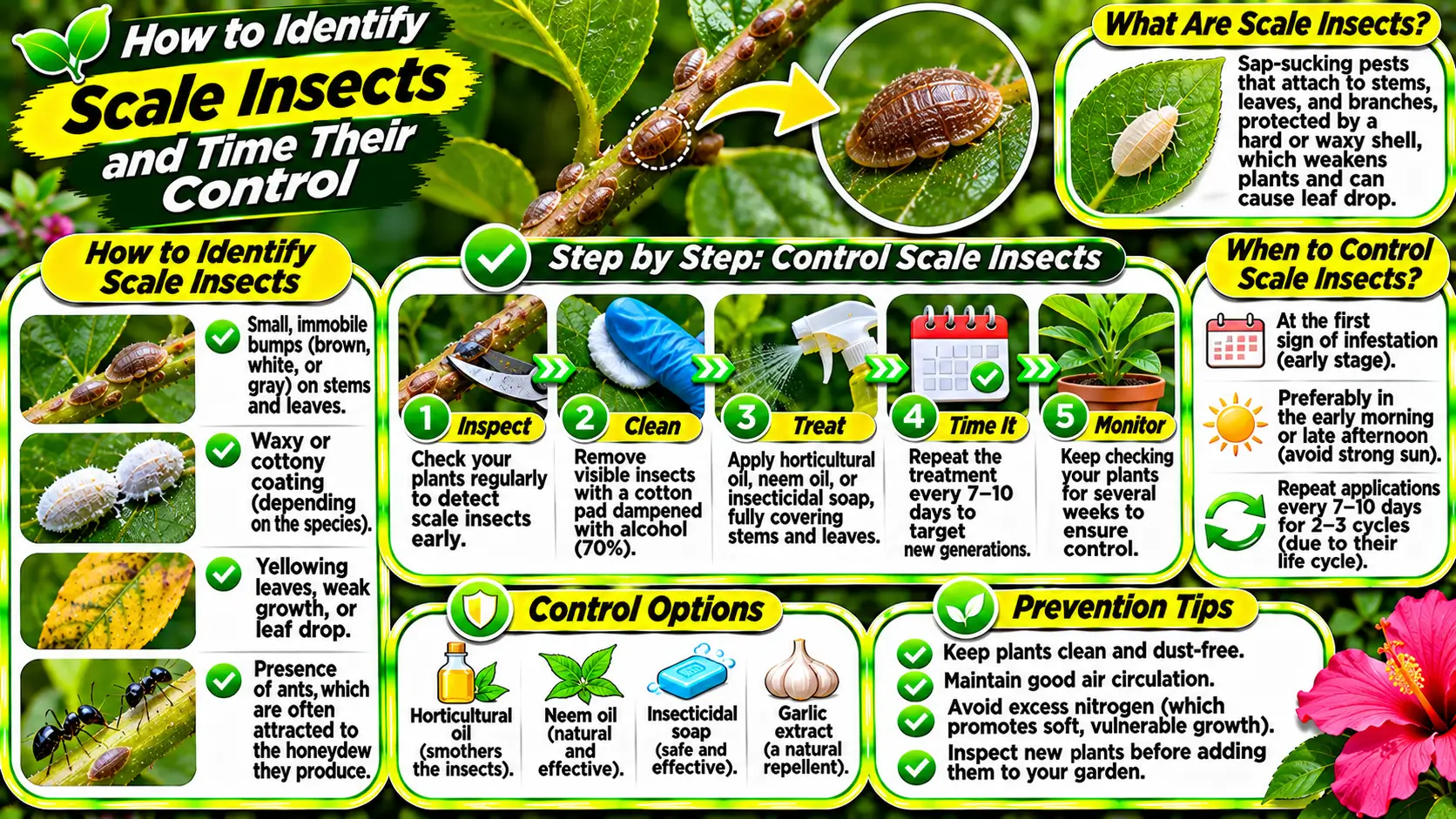
Soft scales and armored scales need different diagnosis
Scale insects are not all managed in the same way. Soft scales often produce honeydew, which can attract ants and support black sooty mold. Armored scales have a separate protective covering and generally do not produce honeydew. Both may look like fixed bumps on stems or leaves, so scrape or lift a small specimen carefully to inspect what is beneath the cover. Correct identification matters because host plants, life cycles, and effective treatment timing vary among scale species.
This guide focuses on distinguishing soft scales from armored scales and timing control around the vulnerable crawler stage. Correct identification and treatment timing are its central topics.
Check whether the scale is alive before treating. Old empty covers may remain attached after the insect has died. Look for living tissue beneath the covering, fresh crawlers, new yellowing, or ongoing decline. A few scales on a vigorous plant may be tolerated or removed manually; widespread infestation on a valuable tree may require expert identification.
Time scale insect control to the crawler stage
Newly hatched crawlers are mobile and usually less protected than settled adults. Their appearance is often the most useful window for contact treatments, but timing differs by species and climate. Monitor with a hand lens, by gently tapping an infested branch over white paper, or by placing a small piece of double-sided tape near the infestation and checking it regularly. Do not copy a calendar date from a regional guide without confirming the local life cycle.
| Scale observation | Interpretation | Management decision |
|---|---|---|
| Hard, dry covers with no live insect beneath | May be old or dead scales | Continue monitoring rather than spraying automatically |
| Sticky honeydew and ants | Soft scales or another honeydew-producing pest may be present | Inspect stems and leaf undersides to confirm |
| Mobile tiny crawlers on tape or paper | New generation is dispersing | Check registered contact options and timing |
| Heavy infestation on a large tree | May exceed practical home treatment | Seek local extension or licensed arborist advice |
University of Minnesota Extension emphasizes identifying the scale species and targeting the crawler stage; soaps and horticultural oils require direct contact and may need repeat applications according to the label. Oils can injure sensitive plants under heat or other stress, so test a small area and follow product restrictions. Protect pollinators and avoid unnecessary broad-spectrum or systemic treatments.
Related Gardening Guides
Explore these related guides for more practical ideas and plant-care advice:
- How to Identify and Control Scale Insects on Garden and Houseplants
- How to Detect and Manage Whiteflies on Indoor and Outdoor Plants
- How to Identify and Control Thrips on Garden and Houseplants
What scale insects look like
Scale insects are small sap-feeding pests that often resemble bumps, shells, or waxy spots attached to stems, leaf veins, and the undersides of leaves. Their appearance can make them easy to mistake for part of the plant. Many adult females remain nearly motionless beneath a protective covering while feeding, so an infestation may be established before it is noticed. Colors vary by species and can include tan, brown, gray, white, or reddish tones. Look for clusters along young stems, leaf midribs, and branches rather than expecting to see insects moving across the foliage.
Table of Contents
- What scale insects look like
- Armored scales and soft scales
- Symptoms of an infestation
- Confirm the pest before treating
- Isolate and inspect plants
- Pruning and physical removal
- Using horticultural oils and soaps
- Protect plants from treatment injury
- Ants, honeydew, and sooty mold
- Prevention and plant care
- Monitoring after treatment
- When to seek expert help
- A practical management routine
- Soft scales and armored scales need different diagnosis
- Time scale insect control to the crawler stage
- Frequently Asked Questions
Armored scales and soft scales
Two broad groups are commonly encountered in gardens. Armored scales produce a separate protective cover and generally do not produce honeydew. Soft scales have a softer body covering and commonly excrete sticky honeydew as they feed. This distinction matters because honeydew can coat leaves, attract ants, and encourage sooty mold. A useful field clue is to inspect the surface beneath a suspected scale: the cover of an armored scale may lift away while the insect remains attached to the plant, whereas the body of a soft scale is more integrated with its covering. Accurate identification to species may require a local extension service.
Symptoms of an infestation
Early symptoms can be subtle. Leaves may lose color, develop yellow patches, curl, or fall prematurely. Heavily affected branches may grow poorly or die back. Soft scale infestations can leave glossy, sticky deposits on leaves, furniture, or surfaces below indoor plants. Sooty mold may develop on honeydew, creating a dark coating that reduces the amount of light reaching leaf tissue. These symptoms are not exclusive to scale insects, so inspect the plant closely before choosing a treatment. Check both sides of leaves, stems, branch junctions, and nearby plants.
Confirm the pest before treating
Use a hand lens and examine several suspicious bumps. Some harmless structures, lenticels, and natural plant growths can resemble scale. Gently test a few with a fingernail or cotton swab; living scale may be moist beneath a cover, while old shells can be dry and empty. Look for crawlers, the mobile immature stage, especially on leaf edges and around established colonies. A strip of clear tape pressed lightly against a branch can sometimes collect tiny crawlers for inspection. Photograph the affected plant and note which parts are involved if identification help is needed.
Isolate and inspect plants
For houseplants, move an infested specimen away from other plants as soon as scale is suspected. Inspect neighboring plants, including those that appear healthy, because crawlers can spread before adults become obvious. Outdoors, mark affected plants and check nearby hosts rather than moving them unnecessarily. Avoid carrying prunings through the garden while they are uncovered; bag heavily infested material and dispose of it according to local guidance. Clean tools and work surfaces after handling an affected plant. Quarantine is particularly useful for newly purchased plants, which should be inspected before joining an indoor collection.
Pruning and physical removal
For a small infestation, physical removal may be enough to reduce pest numbers. Prune badly infested twigs when doing so will not damage the plant’s structure or remove an excessive amount of healthy growth. On sturdy leaves and stems, wipe individual scales away with a damp cloth or gently scrape them off without injuring the bark. A cotton swab can help reach tight spaces, but test delicate foliage first. Repeat inspections are essential because hidden individuals and newly hatched crawlers may remain after the first cleaning. Do not strip a plant of healthy leaves simply to remove a few isolated scales.
Using horticultural oils and soaps
Horticultural oils can help control susceptible scale stages by coating insects, while insecticidal soaps work through direct contact with exposed, soft-bodied stages. These products are not interchangeable with household detergents or cooking oils. Choose a product labeled for the plant and pest, and follow its directions exactly. Coverage matters: stems, leaf undersides, and sheltered colonies may be missed by a casual spray. Some scales are harder to control once their protective covers have formed, so timing applications around crawler activity can improve results. Repeat only as directed on the label.
Protect plants from treatment injury
Never assume that a product is harmless because it is marketed as natural or suitable for gardens. Oils and soaps can injure drought-stressed plants, tender new growth, or sensitive species, especially in hot, sunny conditions. Test a small area first and wait the period specified by the label before treating the whole plant. Avoid spraying during heat, strong sun, or other conditions prohibited by the product instructions. Do not combine products unless the labels specifically allow it. Keep people and pets away from treated areas for the period stated on the label.
Ants, honeydew, and sooty mold
Ants may protect honeydew-producing soft scales because they collect the sugary liquid. Their activity can therefore signal a sap-feeding pest, although ants alone do not prove that scale is present. Managing the scale population is the central step; reducing ant access may also help where appropriate. Sooty mold usually grows on honeydew rather than infecting the plant itself. Once the source of honeydew is controlled, the dark coating can often be gently washed from suitable foliage. Avoid harsh scrubbing that damages leaves, and do not treat mold without addressing the insect producing the honeydew.
Prevention and plant care
Inspect new plants carefully, especially along stems and leaf undersides, and keep them separate during an observation period. Avoid placing indoor plants so tightly together that inspection and airflow become difficult. Clean fallen leaves and dead material, and prune crowded growth when appropriate for the species. Provide suitable light, watering, and nutrition: a stressed plant may tolerate pest feeding poorly, while excessive fertilizer can encourage soft growth that attracts some sap-feeding insects. Healthy care does not guarantee pest-free plants, but it makes problems easier to detect and manage.
Monitoring after treatment
Check the plant every few days at first, then continue weekly inspections for several weeks. Look for fresh crawlers, new colonies, sticky honeydew, and continuing leaf decline. Old scale covers may remain attached after the insect is dead, so do not judge treatment success only by whether every bump disappears. Instead, inspect whether living insects remain beneath covers and whether new growth is healthy. Record the date and product used so that repeat applications, if permitted, follow the label’s interval. If the infestation continues to spread, seek local identification and treatment advice.
When to seek expert help
Large trees, valuable landscape plants, unusual scale species, and infestations that persist despite careful treatment may need professional assessment. A local horticulture extension service or qualified arborist can help identify the pest and determine whether intervention is justified. Avoid applying broad-spectrum insecticides simply because a plant looks unhealthy; misdiagnosis can harm beneficial insects without solving the actual problem. The most reliable approach combines correct identification, early detection, selective physical control, and a labeled treatment when necessary.
A practical management routine
Begin by identifying the host plant and checking the entire specimen. Isolate indoor plants, photograph the infestation, and determine whether the insects are armored or soft scales when possible. Remove heavily affected material selectively, clean accessible colonies, and choose a labeled product only if the level of infestation warrants it. Monitor new growth and nearby plants, while improving care conditions without overwatering or overfertilizing. Scale insects can be persistent, but a measured routine is usually more effective than repeated, unplanned spraying.
Scale insect identification and treatment guide
| Observation | Possible scale type or issue | What to check |
|---|---|---|
| Hard, shell-like bumps | Often armored scale | Look for fixed covers on stems and leaves |
| Soft, rounded insects | May be soft scale | Check for honeydew and sooty mold |
| Yellowing or weak growth | Possible feeding injury | Inspect veins, stems, and leaf undersides |
| Small or localized infestation | May be manageable with physical removal | Isolate plant and remove carefully |
| Large infestation | Multiple life stages may be present | Monitor repeatedly and use labeled products if needed |
| After treatment | New crawlers may emerge later | Reinspect and repeat only as label permits |
For further information, consult University of Minnesota Extension guidance on scale insects.
Explore these related guides:
- How to Prevent and Manage Whiteflies in the Garden
- How to Monitor and Manage Thrips on Indoor and Outdoor Plants
Soft scales and armored scales need different diagnosis
Scale insects are not all managed in the same way. Soft scales often produce honeydew, which can attract ants and support black sooty mold. Armored scales have a separate protective covering and generally do not produce honeydew. Both may look like fixed bumps on stems or leaves, so scrape or lift a small specimen carefully to inspect what is beneath the cover. Correct identification matters because host plants, life cycles, and effective treatment timing vary among scale species.
Check whether the scale is alive before treating. Old empty covers may remain attached after the insect has died. Look for living tissue beneath the covering, fresh crawlers, new yellowing, or ongoing decline. A few scales on a vigorous plant may be tolerated or removed manually; widespread infestation on a valuable tree may require expert identification.
Time scale insect control to the crawler stage
Newly hatched crawlers are mobile and usually less protected than settled adults. Their appearance is often the most useful window for contact treatments, but timing differs by species and climate. Monitor with a hand lens, by gently tapping an infested branch over white paper, or by placing a small piece of double-sided tape near the infestation and checking it regularly. Do not copy a calendar date from a regional guide without confirming the local life cycle.
| Scale observation | Interpretation | Management decision |
|---|---|---|
| Hard, dry covers with no live insect beneath | May be old or dead scales | Continue monitoring rather than spraying automatically |
| Sticky honeydew and ants | Soft scales or another honeydew-producing pest may be present | Inspect stems and leaf undersides to confirm |
| Mobile tiny crawlers on tape or paper | New generation is dispersing | Check registered contact options and timing |
| Heavy infestation on a large tree | May exceed practical home treatment | Seek local extension or licensed arborist advice |
University of Minnesota Extension emphasizes identifying the scale species and targeting the crawler stage; soaps and horticultural oils require direct contact and may need repeat applications according to the label. Oils can injure sensitive plants under heat or other stress, so test a small area and follow product restrictions. Protect pollinators and avoid unnecessary broad-spectrum or systemic treatments.
Related Gardening Guides
Explore these related guides for more practical ideas and plant-care advice:
- How to Identify and Control Scale Insects on Garden and Houseplants
- How to Detect and Manage Whiteflies on Indoor and Outdoor Plants
- How to Identify and Control Thrips on Garden and Houseplants
Frequently Asked Questions
How can I tell soft scale from armored scale?
Soft scales often produce honeydew, while armored scales generally do not. Their covers and appearance can differ, but use magnification and reliable identification guidance because treatments may vary.
What is the crawler stage of scale insects?
Crawlers are newly hatched mobile young that move before settling on plant surfaces. They are often more vulnerable to certain control methods than mature, protected scales.
Can I remove scale insects by hand?
For small infestations, carefully removing individual insects or pruning heavily affected parts may help. Check nearby stems and leaf undersides, and clean tools after working on an infested plant.
Why do scale insects return after treatment?
Eggs or protected stages may survive, and new crawlers can emerge later. Reinspect the plant and follow repeat-treatment instructions on any product label rather than applying products more frequently than directed.


5 thoughts on “How to Identify Scale Insects and Time Their Control”