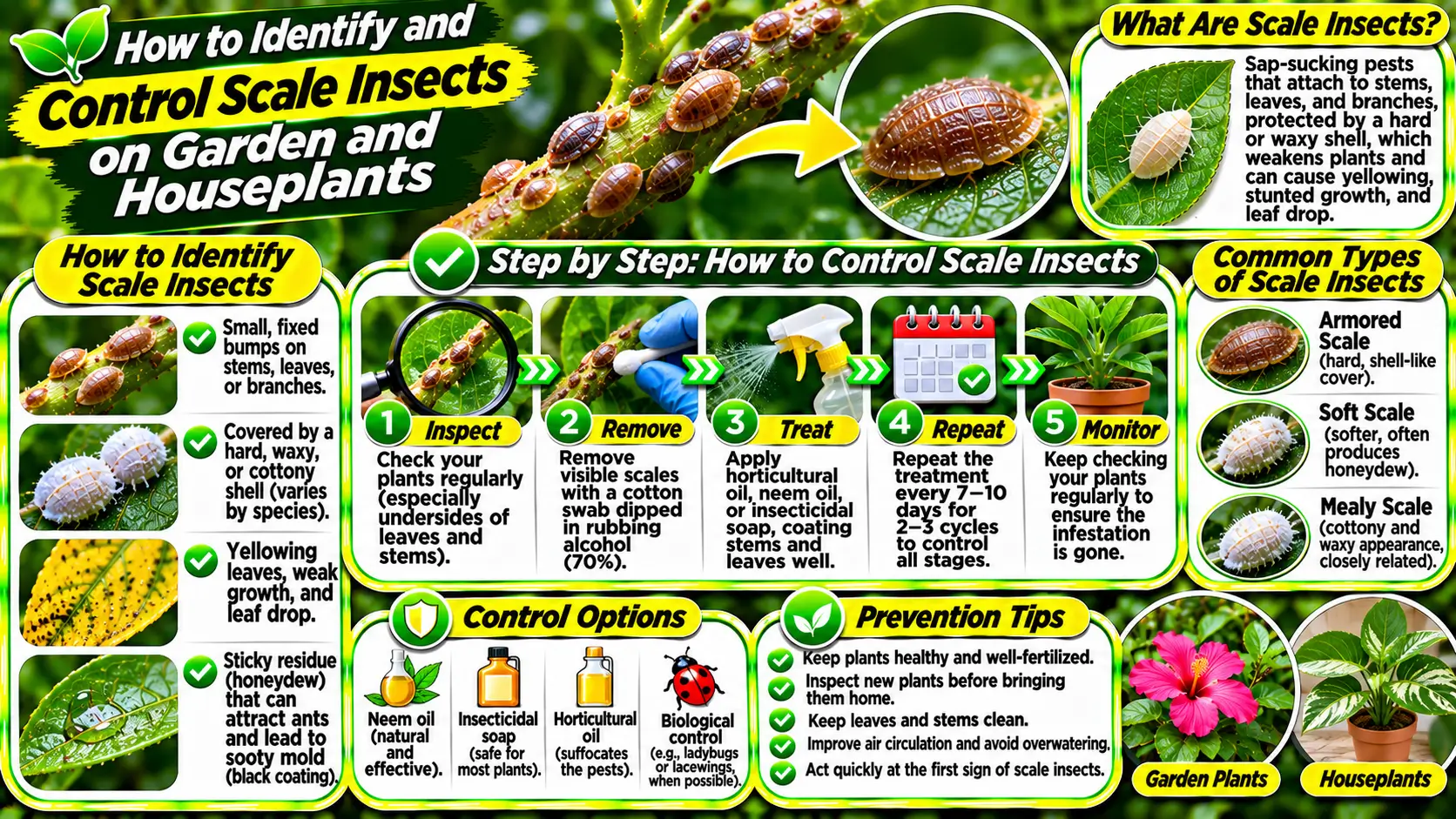
Scale insects are sap-feeding pests that attach themselves to stems, leaves, and sometimes fruit. Many species look like tiny bumps rather than moving insects, which is why an infestation can go unnoticed for weeks. Their protective covering may be brown, tan, gray, white, or waxy, depending on the species and life stage. Some are soft-bodied and produce honeydew, while armored scales have a harder cover and generally do not produce the same sticky residue. Both types weaken plants by extracting sap.
This guide is an introductory identification and response guide for scale insects on garden plants and houseplants. It covers recognition, confirmation, isolation, and first management steps before more specialized treatment decisions.
Table of Contents
- Recognizing the signs
- Confirming the diagnosis
- Where infestations begin
- Isolating and cleaning affected plants
- Choosing a control method
- Why timing and life stages matter
- Protecting beneficial insects
- Preventing future outbreaks
- Monitoring recovery
- A practical management plan
- Check whether scale covers are alive before treating
- Frequently Asked Questions
Recognizing the signs
Look for small, fixed bumps along leaf veins, stems, branch joints, and the undersides of leaves. Leaves may become pale, yellow, or mottled, and new growth can appear weak or distorted. Soft scale species often leave shiny honeydew on foliage or nearby surfaces. That sugary residue can attract ants and encourage sooty mold, a dark fungal growth that coats leaves and reduces the light reaching them. Armored scale may cause yellow halos or localized discoloration around feeding sites without obvious honeydew.
Confirming the diagnosis
Inspect several parts of the plant with a hand lens. A scale cover can sometimes be lifted gently with a fingernail or a blunt tool; the soft insect beneath is evidence of an active infestation. Do not assume every bump is a pest, because lenticels, buds, and natural stem features can look similar. Check whether the bumps occur in organized clusters and whether nearby leaves show symptoms. Examine neighboring plants too, since crawlers can spread to plants touching an infested specimen.
Where infestations begin
Scale insects often arrive on newly purchased plants, cuttings, or plant material brought indoors. They may also move from outdoor plants into sheltered patios, greenhouses, and homes. Crowded foliage, poor air circulation, and plants under drought or nutrient stress can make pest problems harder to detect and manage. Ant activity may be an additional clue where honeydew-producing species are present. Quarantine new plants and inspect them carefully before placing them beside an established collection.
Isolating and cleaning affected plants
Move an infested container away from healthy plants when practical. Remove heavily infested leaves or small branches if doing so will not seriously damage the plant, and place the debris in a sealed bag rather than leaving it near the growing area. Wipe accessible stems and leaf surfaces with a damp cloth or cotton swab. For sturdy plants, a gentle rinse can dislodge some insects, but avoid damaging delicate foliage or saturating the potting mix.
Choosing a control method
For a small infestation, manual removal can be effective when repeated carefully. A soft brush or cotton swab can help loosen scales from sturdy stems. Insecticidal soap or horticultural oil may be useful against susceptible stages, but coverage is essential and the product label must list the plant and pest or provide appropriate directions. Test a small area first, because some plants react to oils or soaps. Never apply products in hot direct sun or to drought-stressed plants unless the label specifically allows it.
Why timing and life stages matter
The mobile crawler stage is usually more vulnerable than adults protected beneath waxy or armored coverings. Crawlers are extremely small and may appear as moving yellow, orange, or pale dots around established scales. Sticky monitoring cards are not a complete solution, but regular close inspection can help reveal activity. Because eggs and protected adults may survive an initial treatment, one application rarely solves a persistent infestation. Follow label intervals and repeat inspections rather than increasing concentration.
Protecting beneficial insects
Predatory beetles, lacewings, parasitic wasps, and other natural enemies can suppress some scale populations outdoors. Broad-spectrum insecticides may kill these helpful organisms and make later outbreaks more severe. Avoid spraying flowering plants when pollinators are visiting, and choose the least disruptive suitable method. Ants sometimes protect honeydew-producing scales from natural enemies, so managing ant access may support biological control. Do not introduce beneficial insects unless the species, release conditions, and local suitability are understood.
Preventing future outbreaks
Inspect the stems, leaf undersides, and growing points of every new plant. Keep plants spaced so foliage does not remain pressed together, and prune dead or congested growth when appropriate. Clean pruning tools between plants, especially after removing infested material. Avoid excessive nitrogen fertilization, which can encourage soft, lush growth that is attractive to some sap-feeding pests. Maintain consistent watering and suitable light so plants can tolerate limited feeding damage.
Monitoring recovery
After treatment, examine marked branches and leaves every few days at first, then continue weekly checks for several weeks. Look for new crawlers, fresh honeydew, expanding colonies, or continuing yellowing. Old scale covers can remain attached after the insect dies, so the presence of a bump alone does not prove treatment failure. Compare new growth and the condition of the plant over time. If the infestation continues to spread despite careful management, seek local horticultural advice or an appropriate plant diagnostic service.
A practical management plan
Successful scale management combines accurate identification, isolation, physical removal, carefully selected treatments, and patience. Start with the least disruptive approach that fits the plant and severity of the infestation. Record where scales occur and when you inspect or treat, so you can judge whether numbers are declining. Avoid applying several products together or exceeding label rates. With consistent monitoring and better plant hygiene, many small and moderate infestations can be brought under control while reducing unnecessary harm to the garden ecosystem.
A useful habit is to inspect plants at the same time each week and compare the newest growth with earlier observations. Consistency makes subtle changes easier to notice and reduces the chance that a problem will be mistaken for normal aging. Keep notes about the plant, location, symptoms, weather, watering, and any intervention. These details help identify patterns and make it easier to judge whether the approach is working.
Avoid treating a plant solely because a symptom resembles a photograph or a description online. Several pests, diseases, and environmental problems can produce similar signs. Examine the affected tissue closely, consider the recent growing conditions, and seek a reliable diagnosis when the plant is valuable or the problem is spreading. Correct identification saves time and helps prevent unnecessary pesticide use.
Always adapt care to the plant species and local conditions. A method suitable for a tough outdoor shrub may injure a delicate tropical houseplant or a young seedling. Read product labels completely, observe protective equipment and re-entry instructions, and follow local regulations. More product or more frequent treatment does not necessarily mean better control; careful timing and coverage are more important.
When several plants are affected, work from healthy plants toward affected ones and clean tools between groups. Keep new plants separate until they have been inspected, and avoid sharing unclean pots, trays, soil, or cuttings. These simple precautions reduce the movement of pests and pathogens through a collection and make it easier to contain a localized problem before it becomes widespread.
Recovery is often gradual. Existing scars, dead tissue, and old lesions may remain after the cause has been controlled, so evaluate the plant by the condition of new growth and whether fresh symptoms continue to appear. Maintain suitable light, water, nutrition, and spacing while the plant recovers. Avoid heavy pruning or fertilizing as an immediate response unless the plant’s needs clearly justify it.
Scale insect inspection and response
| Sign | What to investigate | Response |
|---|---|---|
| Raised bumps on stems or leaves | Check whether covers are armored or soft-bodied scales | Confirm identification before treatment |
| Sticky honeydew | May indicate soft scale feeding | Inspect nearby leaves for sooty mold and ants |
| Yellowing or leaf drop | Possible prolonged feeding stress | Check stems and leaf veins closely |
| Small infestation | Scales may be physically removable | Isolate and remove carefully |
| Persistent infestation | New crawlers may continue to emerge | Monitor and use only labeled products as directed |
For additional expert recommendations, see University of Minnesota Extension guidance on scale insects.
Related guides:
- How to Identify and Control Thrips on Garden and Houseplants
- How to Detect and Manage Whiteflies on Indoor and Outdoor Plants
Further plant health guides:
- How to Identify Scale Insects and Time Their Control
- Damping-Off in Seedlings: Disease Causes, Symptoms, and Early Response
Check whether scale covers are alive before treating
Old scale covers can remain attached long after the insect has died. Treating every visible bump can therefore lead to unnecessary applications. On a small sample, gently lift or press a few covers with a fingernail or blunt tool. A live individual often contains moist body tissue; a dead one may be dry, hollow, or crumbly. This field check is not a substitute for expert identification, but it helps determine whether an infestation is still active. Avoid damaging stems or scraping bark while inspecting.
For armored scales, the protective cover can be separated from the insect beneath it; soft scales have a different body structure and often produce honeydew. Look for fresh crawlers, which are tiny and mobile before they settle and form a protective covering. A small piece of double-sided tape placed around an infested twig can help reveal crawler movement, although dust and debris make the tape difficult to interpret without magnification. Record the date and location of crawler observations because timing differs by species and climate.
University of Maryland Extension recommends checking for live scales, crawlers, natural enemies, and signs of parasitism rather than judging population size from attached covers alone. Its scale insect monitoring guide explains these inspection clues. If the plant is recovering and most remaining covers are dead, continue monitoring before applying another treatment. When crawlers are active, choose only a locally registered product labeled for the host and scale type, and protect beneficial insects.
Related Gardening Guides
Explore these related guides for more practical ideas and plant-care advice:
- How to Identify Scale Insects and Time Their Control
- How to Detect and Manage Whiteflies on Indoor and Outdoor Plants
- How to Identify and Control Thrips on Garden and Houseplants
Frequently Asked Questions
How can I tell whether a bump on a plant is a scale insect?
Scale insects often appear as small fixed bumps on stems or leaf surfaces. Check whether the covering can be gently lifted and look for honeydew, sooty mold, or nearby crawlers; other plant structures can look similar.
Do scale insects move from one plant to another?
Most mature scales remain attached, but young crawlers can move to nearby growth and plants. Infested plants and plant material can also introduce them.
When are scale insects easiest to control?
The mobile crawler stage is often more vulnerable than mature insects protected by a waxy or armored covering. Monitor for crawlers and follow species-appropriate local guidance.
Should I throw away a plant with scale insects?
Not always. Small infestations may be manageable with isolation, careful removal, pruning, and repeated monitoring. Consider disposal when the infestation is severe or the plant cannot be treated safely.


4 thoughts on “How to Identify and Control Scale Insects on Garden and Houseplants”