Start with the border’s purpose
A garden border can soften a fence, frame a path, screen an unattractive view, attract pollinators, or connect different parts of the landscape. Decide what the border needs to accomplish before choosing plants. A narrow strip beside a path may need compact plants that do not spill into the walking area. A deep border along a boundary can support shrubs, perennials, grasses, and small trees in layers. Consider the view from both directions, including windows inside the house. The purpose influences plant height, density, color, and maintenance. A border designed for screening will differ from one intended as a changing seasonal display.
Table of Contents
- Start with the border’s purpose
- Assess light and soil before selecting plants
- Build a framework with shrubs and structural plants
- Arrange plants by height and viewing angle
- Combine foliage textures
- Plan a sequence of flowers through the seasons
- Use color with a consistent palette
- Plant in groups and repeat key varieties
- Prepare the border and maintain healthy spacing
- Keep the border interesting beyond flowering
- Frequently Asked Questions
Assess light and soil before selecting plants
Record how much direct sunlight the border receives and whether nearby walls or trees create dry shade. Check the soil’s drainage and texture, and observe whether water collects after heavy rain. Soil conditions can vary within a single garden, especially near foundations, paths, and mature trees. Choose plants that suit the actual conditions rather than trying to force every border into the same style. If soil improvement is needed, use amendments appropriate to the plants and site. Avoid adding large amounts of fertilizer without understanding soil fertility. Healthy plant selection begins with matching species to the environment in which they will grow.
Build a framework with shrubs and structural plants
The framework gives a border shape when flowers are not in bloom. Evergreen shrubs, compact deciduous shrubs, ornamental grasses, and plants with distinctive foliage can provide this structure. Use them as repeated anchors rather than scattering many unrelated specimens. Check mature height and spread so that structural plants do not shade smaller neighbors or block paths. In a long border, repeat the same shrub or grass at intervals to create rhythm. In a small border, one or two carefully placed structural plants may be enough. The framework should support the seasonal planting rather than dominate every view.
Arrange plants by height and viewing angle
In a border viewed mainly from one side, taller plants are generally placed toward the back, medium plants in the middle, and low plants near the front. This arrangement allows more of the planting to be seen. However, a rigid height sequence can look artificial. Gentle changes in height and occasional taller accents create a more natural flow. For a border viewed from all sides, place taller plants near the center and graduate toward the edges. Always consider the mature size of plants and leave room for maintenance access. Do not rely on close planting to hide bare soil immediately; overcrowding can lead to poor airflow and competition.
Combine foliage textures
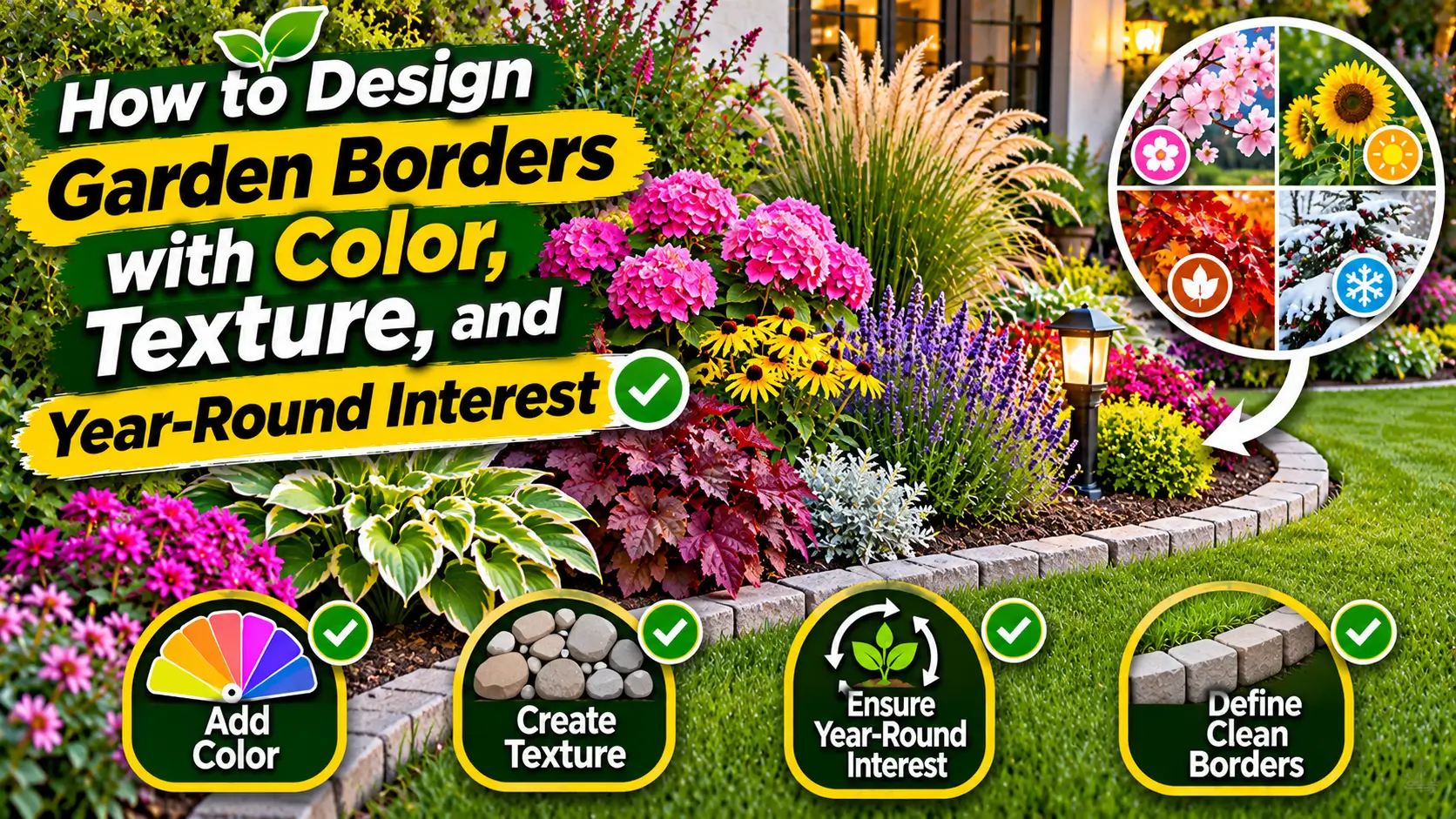
Texture provides interest even when flowers are absent. Broad leaves contrast with narrow grasses, fine fern-like foliage, glossy evergreen leaves, and soft silver surfaces. Repeating a few textures creates unity, while placing contrasting forms beside one another makes individual plants easier to appreciate. Consider the overall scale: very fine textures can disappear from a distance, while large leaves create strong visual blocks. Use foliage color as another layer of contrast, including green, blue-green, burgundy, silver, and variegated forms where they suit the design. A border built around foliage can remain attractive for much longer than one dependent on short flowering periods.
Plan a sequence of flowers through the seasons
Choose plants with overlapping flowering periods so that the border changes gradually rather than having one brief peak. Include early-season bulbs or perennials, summer flowering plants, and late-season varieties that continue into autumn where the climate allows. Add plants with attractive seed heads or persistent berries if they suit the site and local wildlife. Keep a simple calendar of expected bloom times, but remember that weather and local conditions can shift flowering. Avoid buying many plants that all bloom at the same time unless a concentrated display is the goal. A balanced seasonal sequence gives the border continuity and makes it more rewarding to observe.
Use color with a consistent palette
A limited color palette often makes a border look more intentional. You might combine cool blues, purples, and whites for a calm effect, or use warm yellows, oranges, and reds for energy. Green foliage acts as the connecting background. Repeat key flower colors in more than one location so the design feels related. Consider the colors of nearby walls, fences, paving, and buildings. Strong colors can be used as accents, while softer tones help a border blend into the landscape. Do not overlook the effect of flower color at different times of day and against the surrounding foliage.
Plant in groups and repeat key varieties
A single plant can look isolated in a large border, while groups create stronger visual impact. Plant in odd-numbered or flowing groups where appropriate, and repeat those groups along the length of the border. Repetition helps the eye move through the space and makes a mixed planting feel connected. The number of plants in each group depends on mature spread and the available area. Follow spacing recommendations and allow room for growth. If the budget is limited, plant the main structure first and expand groups over time rather than filling every gap with unrelated small plants.
Prepare the border and maintain healthy spacing
Remove persistent weeds before planting and loosen compacted soil without damaging nearby tree roots or underground services. Add organic matter only where it is suitable for the soil and intended plants. Arrange pots on the ground before planting so you can adjust the composition and check spacing. Water plants thoroughly after installation and apply mulch where appropriate. During the first growing season, monitor moisture while roots establish. Remove damaged growth and divide crowded perennials when needed. Good spacing supports airflow, reduces competition, and makes future maintenance easier.
Keep the border interesting beyond flowering
A successful border should have something to offer when flowers fade. Evergreen forms, ornamental grasses, textured bark, seed heads, and plants with attractive winter silhouettes can carry the design through quieter months. Leave healthy stems standing when they provide habitat or visual interest, while removing diseased material and anything that creates a safety or hygiene problem. Review the border at the end of each season and note gaps, overcrowding, and plants that underperformed. Small adjustments over time are more effective than replacing the entire border whenever one combination fails. With a clear structure, repeated forms, and a thoughtful seasonal sequence, a garden border can remain attractive throughout the year.
A cohesive border benefits from repetition, contrast, rhythm, and a controlled mix of foliage textures and seasonal color. For a deeper explanation of these design principles, see Penn State Extension’s principles of garden design for practical guidance.
Elements of a balanced garden border
| Element | Visual contribution | Design tip |
|---|---|---|
| Structure plants | Shape and year-round framework | Place taller or evergreen forms as anchors |
| Flowering plants | Seasonal color | Stagger bloom times for continuity |
| Foliage texture | Contrast and depth | Mix leaf sizes and shapes |
| Ground layer | Connects the border visually | Use suitable low-growing plants or mulch |
| Repeating colors | Creates rhythm and cohesion | Repeat a few colors rather than using every color |
Related Gardening Guides
Explore these related guides for more practical ideas and planning advice:
- How to Choose Trees and Shrubs for a Balanced Landscape
- How to Choose the Right Garden Style for Your Home
- How to Create a Beautiful Garden with Different Levels and Heights
- How to Design a Garden Layout That Is Both Beautiful and Practical
- Small Garden Design Ideas That Make Limited Outdoor Spaces Feel Larger
Frequently Asked Questions
How deep should a garden border be?
There is no single ideal depth. Base it on the mature size of the plants, viewing distance, available space, and whether the border is seen from one side or several. Leave room for access and maintenance.
How do I keep a garden border interesting all year?
Combine plants with different flowering seasons, evergreen structure, varied foliage, and seed heads or stems that remain attractive when appropriate. Choose species suited to the local climate and site.
Should plants in a border be arranged in straight rows?
Rows can work in formal designs, but grouped drifts and repeated shapes often create a more natural composition. Arrange plants according to mature size and sightlines rather than how they look in small nursery pots.
How can I prevent a mixed border from becoming overcrowded?
Check mature spread before planting, allow space for growth, and review the border as plants establish. Divide or relocate suitable perennials when needed instead of continually adding more plants.
4 thoughts on “How to Design Garden Borders with Color, Texture, and Year-Round Interest”