
Many perennial plants grow into larger clumps over time. The center may become crowded, flowering can decline, and roots may compete for space, water, and nutrients. Dividing a suitable perennial separates a mature clump into smaller sections that can be replanted. This can rejuvenate an established planting, create additional plants, and help manage the size of a border. Division is not appropriate for every perennial, however. Some species have woody crowns or deep taproots and are better propagated by other methods.
Table of Contents
- Identify plants that respond well
- Choose the right season
- Prepare the site before lifting
- Lift the clump carefully
- Separate crowns and roots
- Prune and handle divisions
- Replant at the correct depth
- Aftercare and watering
- Common problems after division
- How often to divide
- A sustainable division plan
- Which perennials should not be divided casually
- Evaluate each division before replanting
- Frequently Asked Questions
Identify plants that respond well
Clump-forming perennials such as many daylilies, hostas, ornamental grasses, and some hardy herbs are commonly divided. Check the growth habit of each species before beginning. Plants that spread by runners, rhizomes, bulbs, or a single central crown may require different techniques. Some perennials resent root disturbance or take years to recover. A reliable plant reference or local horticultural service can help determine whether division is suitable and how frequently it should be done.
Choose the right season
The best time depends on the plant and climate. Many spring-flowering perennials are divided in early autumn, allowing roots to establish before winter. Many summer- and autumn-flowering perennials are divided in spring as new growth begins. Avoid dividing during heat waves, drought, frozen soil, or active flowering unless the species guidance recommends otherwise. Mild weather reduces moisture stress and gives plants time to recover. Local seasonal conditions matter more than a calendar date alone.
Prepare the site before lifting
Choose and prepare the new planting locations before digging up the parent plant. Remove weeds, loosen compacted soil where appropriate, and incorporate organic matter if the soil needs improvement. Check sunlight, drainage, and spacing for the mature size of the perennial. Water the parent plant the day before division if the soil is dry. Preparing first reduces the time roots spend exposed and makes it easier to replant each division promptly.
Lift the clump carefully
Use a spade or garden fork to loosen soil around the plant, working far enough from the crown to avoid cutting through the main root mass. Lift from beneath rather than pulling on stems. For a large clump, work around the perimeter and gradually loosen it. Shake or wash away only enough soil to see the root structure; leaving some soil around delicate roots can reduce drying. Keep the plant shaded while you work.
Separate crowns and roots
Some clumps can be pulled apart by hand, while others require two garden forks placed back-to-back or a clean sharp knife. Each division should have healthy roots and at least one viable growing point or shoot, according to the species. Discard dead, hollow, mushy, or severely damaged sections. Avoid making tiny divisions with too little root mass, because they may struggle to establish. Make clean cuts rather than tearing tough tissues.
Prune and handle divisions
Remove dead leaves, damaged stems, and clearly unhealthy roots. Do not remove healthy foliage indiscriminately, since leaves help the plant recover and produce energy. If the plant has a large amount of top growth relative to its roots, limited trimming may reduce water loss, but the correct amount varies by species. Keep divisions cool and shaded, and cover roots with damp material if planting must be delayed briefly. Do not leave them exposed to wind or sun.
Replant at the correct depth
Set each division at the same depth at which the original plant grew unless species-specific guidance says otherwise. Spread roots naturally and backfill with soil, firming gently to remove large air pockets. Avoid burying crowns too deeply, which can encourage rot, or leaving roots exposed. Space plants according to their mature dimensions rather than their small size immediately after division. Water thoroughly to settle the soil around the roots.
Aftercare and watering
Keep the soil evenly moist while new roots establish, but do not saturate poorly drained ground. Newly divided plants may need more frequent checks than established perennials, particularly in windy or warm weather. Mulch can help moderate soil moisture and temperature, but keep it away from crowns and stems. Delay strong fertilization until the plant is actively growing and follow the nutrient needs of the species. Avoid disturbing the divisions while they recover.
Common problems after division
Wilting may occur because roots have been reduced and cannot yet supply all the foliage. Temporary afternoon wilting can improve as roots recover, but persistent collapse suggests excessive stress, poor watering, or root damage. Yellowing lower leaves may be normal after disturbance, while soft crowns or foul-smelling roots can indicate rot. If a division fails, review the season, root condition, planting depth, and moisture management. Not every small section will survive, so start with healthy material.
How often to divide
There is no universal division schedule. Some vigorous perennials benefit from division every few years, while others can remain undisturbed for much longer. Signs that division may be useful include a dead center, reduced flowering, crowded growth, or a clump extending beyond its space. Divide only when the plant’s condition or garden plan justifies it. Excessive division can reduce flowering and create repeated establishment work.
A sustainable division plan
Division is a practical way to renew suitable perennials and expand a garden without purchasing new plants. Success depends on correct identification, suitable timing, healthy divisions, prompt replanting, and attentive aftercare. Keep a record of the date and number of divisions, and observe how each responds through the next growing season. If the plant is rare or valuable, divide conservatively and retain a healthy parent section as insurance.
Keep a simple propagation log with the plant name, parent plant, date, preparation method, medium, and observations. A record helps distinguish a method that consistently works from one that succeeds only occasionally. It also prevents repeating avoidable mistakes, such as using the wrong part of a stem or keeping the medium too wet. Photographing progress at regular intervals can be useful when changes are slow.
Cleanliness is important throughout propagation. Wash containers before reuse, use fresh or properly prepared growing medium, and clean cutting tools between parent plants. Remove decaying material promptly and do not allow diseased leaves or stems to remain beside healthy propagations. These habits reduce the chance that a small problem will spread through an entire tray or batch.
Do not judge success only by the appearance of the top growth. New leaves can sometimes develop using stored energy before a cutting has formed enough roots. Conversely, a healthy root system may be developing before obvious top growth appears. Follow the expected timing for the species and avoid repeatedly pulling, unwrapping, or moving propagations to check progress.
Match moisture to the plant and method. A medium that is suitable for a soft tropical cutting may be too wet for a succulent or dormant woody stem. Drainage, container size, temperature, airflow, and humidity all influence how quickly water is lost. Check the actual condition of the medium and adjust rather than following a fixed watering schedule.
Be patient and plan for some losses. Even careful propagation does not guarantee that every cutting, leaf, seed, or division will establish. Taking a modest number of extra propagations can account for normal variation, but do not remove so much material that the parent plant is weakened. Choose healthy material, use a suitable method, and give new plants time to become established.
Perennial division planning table
| Situation | Recommended approach | Reason |
|---|---|---|
| Clump is crowded or declining in the center | Check whether the species benefits from division | Some perennials respond well to periodic rejuvenation |
| Plant is flowering or heat-stressed | Wait for a more suitable period | Reduces transplant stress |
| Division is prepared | Keep healthy roots and shoots on each section | Each division needs viable growing points |
| Replanting | Use the original or species-recommended planting depth | Prevents crown and root problems |
| Aftercare | Water in and monitor moisture while roots recover | Supports establishment |
| Unknown plant | Identify it before dividing | Some plants are unsuitable or have special timing |
For expert background and practical recommendations, consult University of Florida IFAS guide to plant propagation techniques.
Explore these related guides:
More related gardening resources:
Additional related guides:
Which perennials should not be divided casually
Division is useful for many clump-forming perennials, but it is not appropriate for every plant. Species with deep taproots, a single woody crown, or roots that resent disturbance may recover poorly when divided. Some plants are better propagated by seed, cuttings, or careful layering. Before lifting a mature specimen, check whether the species tolerates division and whether the recommended season is based on its flowering and dormancy cycle.
Regional calendars should not be copied blindly. Extension recommendations from cold climates often schedule spring- or autumn-flowering perennials around dormancy and frost; in warmer climates, the safer window may instead be a mild, less stressful period when the plant is not flowering and soil moisture can be maintained. Avoid dividing during heat, drought, waterlogging, or active stress.
Evaluate each division before replanting
| Division feature | Good candidate | Weak candidate |
|---|---|---|
| Crown or growing point | At least one healthy, viable crown or shoot | No viable growing point or badly damaged crown |
| Roots | Enough sound roots to support the retained foliage | Severely torn, dry, or decayed roots |
| Foliage | Healthy leaves in proportion to root mass | Excessive top growth on a tiny root section |
| Plant health | Firm tissue without disease symptoms | Soft rot, cankers, or unexplained decline |
| Replanting | Prepared site and correct species-specific depth | Roots left exposed while the site is prepared |
University of Minnesota Extension recommends retaining vigorous shoots and healthy roots, and notes that some perennials are difficult or unsuitable to divide. Mississippi State University Extension similarly advises selecting divisions with strong roots and intact crowns. These are useful principles, but the number of shoots and the best season must be adapted to the species and climate.
Related Gardening Guides
Explore these related guides for more practical ideas and planning advice:
- How to Propagate Plants from Rhizomes: A Practical Step-by-Step Guide
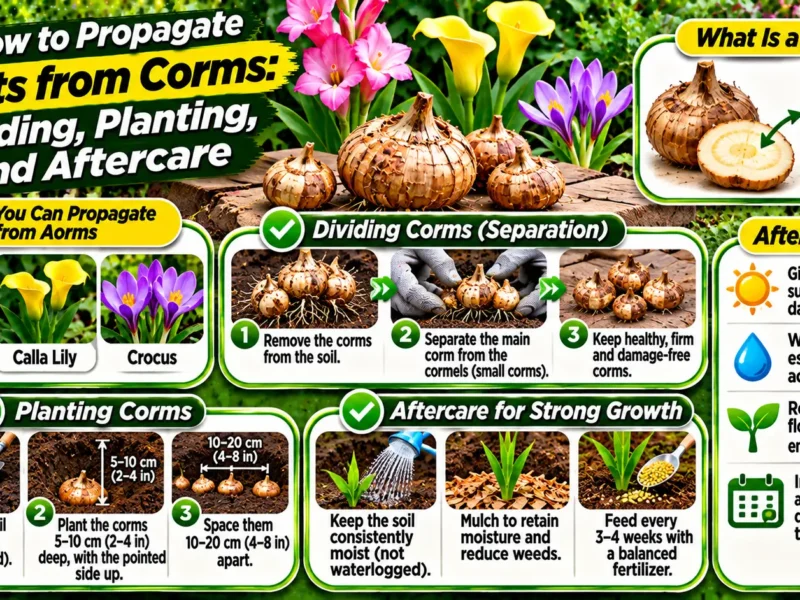
- How to Propagate Plants from Corms: Dividing, Planting, and Aftercare
- How to Propagate Plants from Basal Offsets and Pups
Frequently Asked Questions
Which perennials should not be divided?
Some perennials have a taproot, woody crown, or growth habit that makes division difficult or harmful. Check the species’ propagation requirements before lifting the plant.
When is the best time to divide perennials?
Many are divided during dormancy or in a mild period before strong active growth, but spring- and autumn-flowering plants may have different ideal windows. Follow local and species-specific guidance.
How many sections should I make from one clump?
Make divisions large enough to retain healthy roots and viable shoots or growing points. The number depends on the plant’s size and growth habit; very small divisions may take longer to recover.
Should I water a perennial after dividing it?
Water the new divisions in to settle the soil, then keep moisture appropriate for the species while they establish. Avoid leaving the root zone saturated.
2 thoughts on “How to Divide Perennial Plants for Healthier, More Productive Gardens”