Introduction
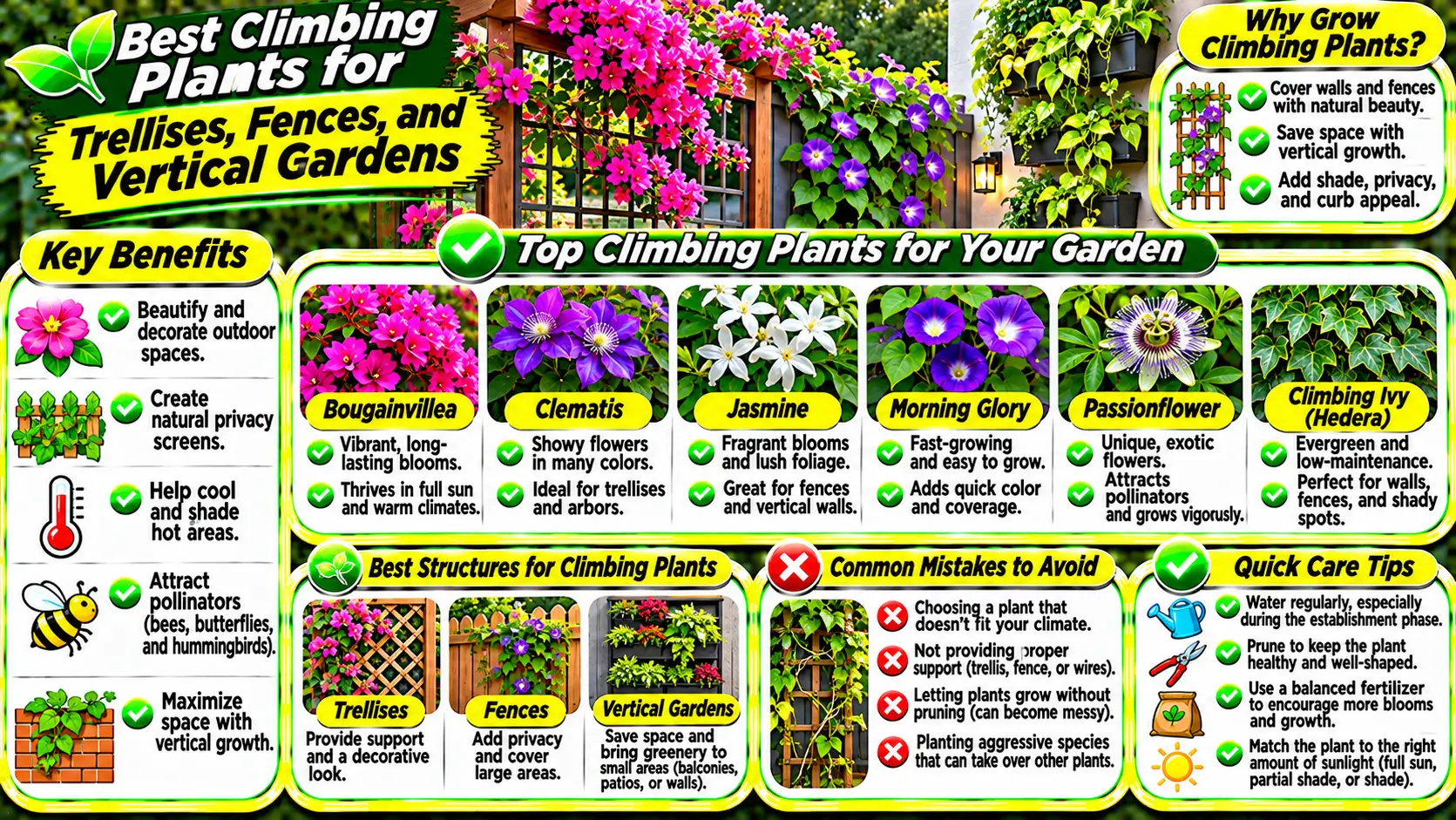
Climbing plants make it possible to add foliage, flowers, and privacy without using the same amount of ground space as a large shrub. They can soften fences, cover a pergola, frame an entrance, or turn a plain wall into a living feature. However, climbers do not all attach themselves in the same way. Some twine around supports, some use tendrils, some cling with adhesive pads or aerial roots, and others simply produce long flexible stems that must be tied in place. Choosing a plant without understanding its climbing habit can lead to damaged structures, tangled growth, or disappointing coverage.Start by deciding what the plant should do. A climber selected for a sunny pergola may not be suitable for a shaded fence. A vigorous vine can cover a large area quickly but may require frequent pruning. A slower plant may be easier to manage in a small courtyard. Consider the local climate, mature size, support strength, water availability, and whether you want flowers, evergreen foliage, fruit, or seasonal color.
Table of Contents
- Introduction
- Understand climbing habits
- Flowering climbers for seasonal impact
- Evergreen climbers for year-round coverage
- Choose a support that can carry the mature plant
- Planting and early training
- Watering, feeding, and pruning
- Managing vigorous growth and plant health
- Match the climber’s attachment method to the support
- Frequently Asked Questions
Understand climbing habits
Twining climbers wrap their stems or leaf stalks around narrow supports. They need wires, strings, trellis bars, or slender poles that they can reach and circle. Tendril climbers produce slender structures that grasp nearby supports; they often need a mesh or framework with suitably spaced openings. Clinging climbers attach directly to surfaces with adhesive pads or aerial roots. These can be effective on suitable walls, but some may leave marks or damage weak masonry, paint, or timber when removed.Scrambling plants do not necessarily climb by themselves. They produce long stems that can be tied to a structure and guided along it. These are often useful where a gardener wants precise placement, but they need regular attention. Identify the plant’s method before choosing a support. A thick wooden post may be too broad for a delicate twiner, while a light decorative trellis may be inadequate for a mature woody vine.
Flowering climbers for seasonal impact
Flowering climbers can create a strong focal point when their light and temperature needs match the site. Clematis varieties, for example, include many growth habits and flowering periods. Their support needs and pruning requirements vary by group, so the exact variety matters. Some prefer their roots shaded and upper growth in brighter light, while others tolerate more sun. Read the cultivar label and learn its pruning group before cutting it back.Jasmine is another popular choice, although the name covers different species with different climates and growth habits. Some are evergreen in warm regions; others are deciduous or need protection from cold. Bougainvillea can provide vivid bracts in warm, sunny, well-drained locations, but it may have thorns and can become vigorous. It is not a universal choice for a small walkway or a place where people brush against it. Choose flowering climbers based on their mature form, not just the appearance of a young nursery plant.
Evergreen climbers for year-round coverage
Evergreen climbers can help maintain screening and structure through the year. Their suitability depends strongly on local temperatures, humidity, rainfall, and the amount of sunlight. Some evergreen vines tolerate shade, while others need bright exposure to maintain dense growth. A plant that is evergreen in a mild climate may lose leaves or suffer damage in a colder location.Before planting an evergreen climber, consider the wall or fence behind it. Dense foliage can reduce airflow and make inspection or maintenance more difficult. Leave access to gutters, vents, windows, and utility equipment. Avoid allowing stems to enter roof spaces or grow into neighboring properties. If the goal is privacy, calculate the coverage needed at maturity and allow enough room for pruning without blocking paths or doors.
Choose a support that can carry the mature plant
The support should be designed for the plant at its mature size, including the weight of wet foliage and wind resistance. A lightweight trellis may support a young vine but fail after several seasons. Secure posts properly and use outdoor-rated fasteners and materials. Wires should be tensioned safely and positioned so stems can be attached without cutting into them. On a wall, a stand-off system can provide space behind the plant for airflow and maintenance.Do not assume a climbing plant can safely attach to every surface. Adhesive pads may be difficult to remove from painted walls, and aerial roots can enter cracks or weak joints. If you are uncertain about the condition of a wall, use a freestanding trellis rather than allowing a climber to attach directly. Keep supports clear of electrical cables, gutters, and other building systems.
Planting and early training
Plant at the recommended depth and distance from the support. A wall may create a rain shadow, leaving the soil near its base drier than expected. Water the root ball before planting and prepare the surrounding soil according to its drainage and structure. Avoid placing the stem so close to the wall that it cannot receive water or airflow. After planting, water thoroughly and monitor moisture during establishment.Guide young stems gently toward the support. Use soft plant ties, clips, or loose loops that do not constrict growth. Arrange stems in the direction you want coverage to develop, and check ties regularly as the plant thickens. Do not force brittle stems around sharp corners. For twining plants, provide narrow enough supports for the stems to wrap around. For tendril climbers, add mesh or thin wires that the tendrils can grasp.
Watering, feeding, and pruning
Watering needs depend on species, container or ground planting, soil, and weather. A climber against a hot wall may dry faster than one growing in open ground. Check moisture near the root zone rather than judging only by surface appearance. During establishment, consistent moisture helps roots spread, but saturated soil can cause root decline. Once established, adjust watering to the plant’s natural preferences.Use fertilizer only when appropriate for the species and soil. Excessive nitrogen can encourage leafy growth at the expense of flowers and may create a dense canopy that is difficult to manage. Prune to remove dead, damaged, or crossing stems and to keep growth away from windows, roofs, and neighboring plants. The right pruning time depends on whether the climber flowers on old or new growth. Identify the species and flowering cycle before making major cuts.
Managing vigorous growth and plant health
Fast-growing climbers can become invasive or difficult to control in some regions. Check local invasive plant lists before purchasing, especially when a vine is known to spread by seed, runners, or fragments. Do not dispose of cuttings in natural areas or waterways. Bag seed-bearing or invasive material according to local waste guidance.Inspect leaves and stems for aphids, scale insects, mites, and fungal symptoms. Good airflow, appropriate spacing, and watering at the soil level can reduce some disease pressure. Avoid spraying broad-spectrum pesticides without identifying the problem; beneficial insects may be helping to control pests. If a climber becomes too large, do not cut it back severely until you know whether it can regrow from old wood. Some species recover readily, while others respond poorly to drastic renovation.
Conclusion
The best climbing plant is one whose growth habit, mature size, and environmental needs fit the structure and the space. Twining vines need narrow supports, tendril climbers need a graspable framework, and clinging plants require careful consideration of the surface they attach to. Flowering and evergreen options can both be effective when chosen for local conditions.Build a strong support before the plant becomes heavy, train young stems early, and keep access to buildings and paths clear. With a suitable species and regular, thoughtful maintenance, a trellis or fence can become a productive vertical garden rather than an uncontrolled tangle.
Climbing plant support and growth habits
| Climbing habit | Support type | Training note |
|---|---|---|
| Tendrils | Thin wires, mesh, or narrow trellis | Provide small elements the tendrils can grasp |
| Twining stems | Poles, wires, or lattice | Guide young stems around supports |
| Clinging roots or pads | Suitable solid surfaces or robust structures | Check potential wall or fence damage |
| Scrambling or sprawling | May need ties or a framework | Secure growth without constricting stems |
| Heavy mature climbers | Strong, securely anchored structures | Plan for mature weight and wind load |
For further practical information, consult University of Minnesota Extension vine and climbing plant guidance.
Explore these related guides:
- Create a Vertical Garden: Structures, Plants, and Maintenance
- Vertical Garden Design: Use Walls and Fences Effectively
More related garden guides:
- Best Plants for Balconies: Choosing Varieties for Sun, Wind, and Space
- Best Native Plants for a Resilient, Wildlife-Friendly Garden
Match the climber’s attachment method to the support
Climbing plants do not all use supports in the same way. Twining stems wrap around narrow poles, tendrils need thin wires or mesh to grasp, and plants with adhesive pads or aerial roots attach directly to suitable surfaces. Some scrambling climbers have no reliable attachment mechanism and must be tied or woven into a framework. A support that works for one climbing habit may be useless for another: thick posts, for example, can be too wide for tendrils to grip.
| Climbing habit | Support that usually works | Management consideration |
|---|---|---|
| Twining stems | Poles, wires, or narrow trellis members | Provide a route for stems to wrap around |
| Tendrils | Thin wires, netting, or narrow lattice | Check mesh spacing and tie young shoots if needed |
| Adhesive pads or aerial roots | Suitable masonry, timber, or purpose-built panels | Check whether attachment can damage the surface or be difficult to remove |
| Scrambling or sprawling stems | Open framework with soft ties | Train and secure growth as it lengthens |
Design the support for the mature plant, not the small nursery pot. Consider the wet weight of foliage, wind loading, access for pruning, and whether the structure is anchored independently of a fence or wall. The University of Minnesota Extension’s grape-growing guidance notes that vigorous vines can become heavy and require sturdy support. Check the attachment habit and mature size of the particular species before installation.
Related Gardening Guides
Explore these related guides for more practical ideas and gardening advice:
- Create a Vertical Garden: Structures, Plants, and Maintenance
- Design Garden Pathways: Materials, Layout, and Practical Tips
- Vertical Garden Design: Use Walls and Fences Effectively
Frequently Asked Questions
How do I choose a climbing plant for a trellis?
Match the plant’s mature size, light and moisture needs, and climbing method to the support. Twining stems, tendrils, clinging roots, and plants that need tying require different structures.
Do climbing plants damage fences or walls?
Some self-clinging climbers can attach to surfaces and complicate maintenance, while vigorous stems can overload weak structures. Use a suitable freestanding support and check the plant’s growth habit.
How far apart should climbing plants be planted?
Follow species-specific spacing guidance and account for mature width and vigor. Fast-growing vines may need more room and more frequent pruning than compact climbers.
When should climbing plants be pruned?
Pruning time depends on whether the plant flowers on old or new growth and on its species. Identify the climber first, then follow timing guidance that avoids removing the next season’s flower buds.
6 thoughts on “Best Climbing Plants for Trellises, Fences, and Vertical Gardens”