Judge whitefly pressure by trends, not one observation
A single cloud of adult whiteflies does not tell you whether a plant population is increasing or whether intervention is necessary. Choose a consistent set of plants and inspect the same number of leaves on each one, including older and younger foliage. Record adult activity when a plant is gently disturbed, but also count or estimate the immature stages attached to leaf undersides. Repeat the inspection at a consistent interval and compare the same locations.
This guide focuses on measuring whitefly pressure through repeatable inspections and population trends. It helps readers decide whether numbers are increasing and whether intervention is justified, rather than simply identifying the pest.
| Observation over repeated checks | What it may indicate | Decision to consider |
|---|---|---|
| Adults appear, but few immatures are found | Transient arrivals or early colonization | Inspect nearby host plants and continue monitoring |
| Immature stages increase on sampled leaves | Successful development on the host | Review plant stress, natural enemies, and targeted control options |
| Counts decline and parasitized scales are visible | Natural enemies may be suppressing the population | Avoid disrupting biological control; keep sampling |
| Honeydew, sooty mold, and leaf yellowing worsen | Feeding pressure may be affecting plant function | Confirm whiteflies and assess whether selective intervention is warranted |
Do not use a universal numerical threshold for every ornamental or garden crop; acceptable pressure depends on plant value, crop stage, species, and local conditions. Sticky cards can help detect adult movement, but they do not measure eggs or settled nymphs. UC IPM’s whitefly management guidance describes life stages and integrated management. Preserve parasitoids and predators, and use only products labeled for the host and pest when monitoring shows a reason to intervene.
Related Gardening Guides
Explore these related guides for more practical ideas and plant-care advice:
- How to Detect and Manage Whiteflies on Indoor and Outdoor Plants
- How to Prevent and Manage Whiteflies in the Garden
- How to Manage Garden Pests with Integrated, Plant-Safe Methods
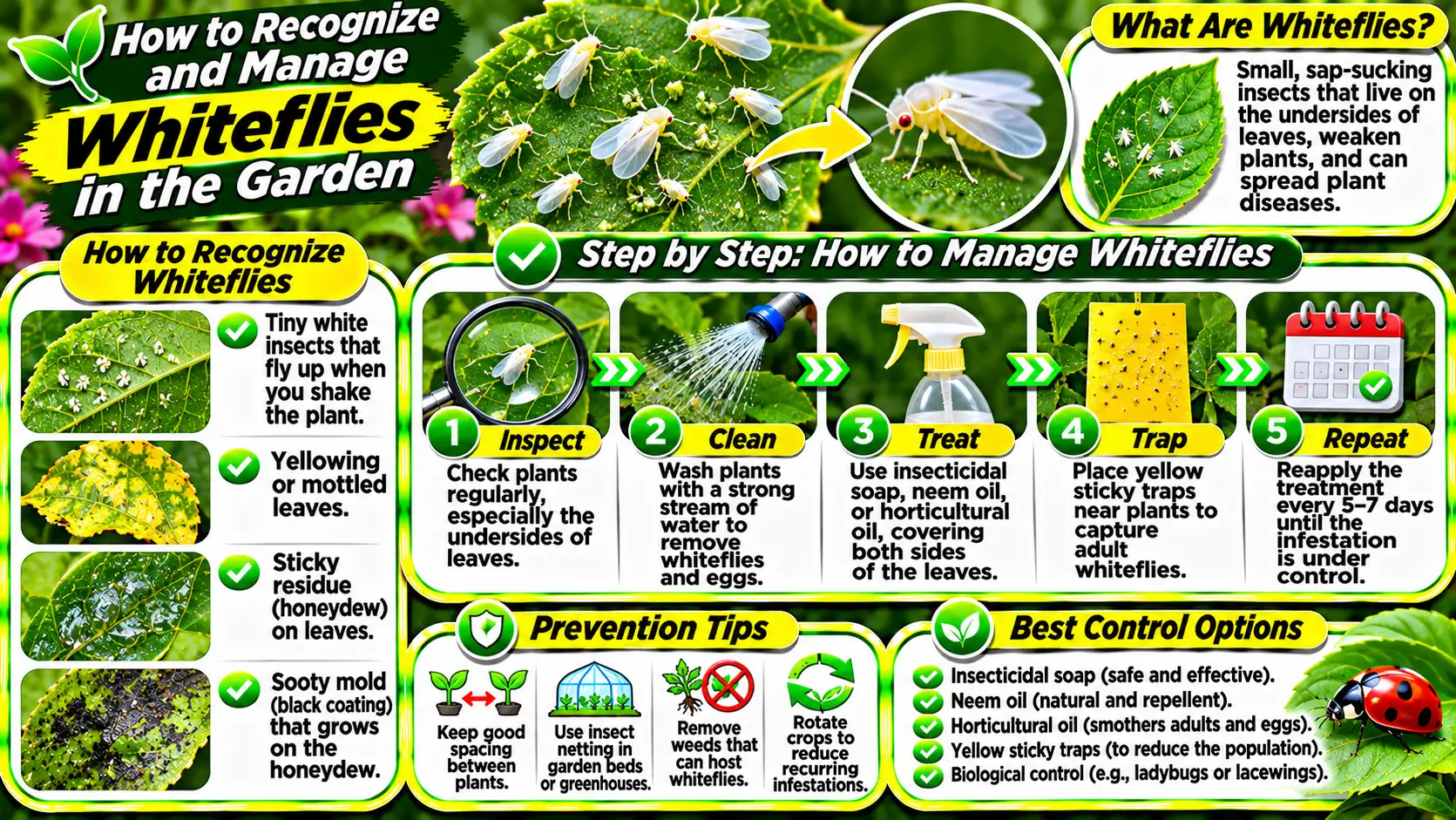
Whiteflies are tiny sap-feeding insects that often gather on the undersides of leaves. When an infested plant is disturbed, the adults may rise in a small cloud, making the problem easy to recognize. Their feeding can weaken plants, cause yellowing, reduce vigor, and leave sticky honeydew that supports sooty mold. Some species also transmit plant viruses. Effective management requires more than spraying the visible adults: eggs and immature stages remain attached to leaves, and new adults can emerge over time. Regular inspection, sanitation, protection of beneficial insects, and carefully selected treatments work together to reduce populations.
Table of Contents
- Recognizing adult whiteflies
- Look for eggs and immature stages
- Symptoms and plant damage
- Inspect plants systematically
- Reduce the population mechanically
- Use soaps and oils with care
- Protect natural enemies
- Manage weeds and growing conditions
- Understand why infestations return
- When to get expert identification
- A practical monitoring routine
- Judge whitefly pressure by trends, not one observation
- Recognize signs of whitefly natural enemies
- Frequently Asked Questions
Recognizing adult whiteflies
Adult whiteflies are small, soft-bodied insects with pale wings covered in a powdery white wax. They usually rest on the undersides of leaves and may fly briefly when foliage is moved. They are not true flies, despite their name. Their size makes them difficult to identify individually without close inspection, so observe the leaf surface and the insects’ behavior. Several species can look similar, and the host plant may provide clues. A hand lens helps distinguish adults from other tiny insects. Do not rely on a quick cloud of flying insects alone; inspect the leaf undersides for eggs and immature stages.
Look for eggs and immature stages
Whitefly eggs are usually laid on leaf undersides, sometimes in arcs or small clusters. After hatching, the first-stage nymphs can move briefly before settling to feed. Later immature stages are flattened, scale-like, and remain attached to the leaf. These stages may look like pale, translucent discs or tiny bumps. Because they do not fly away when disturbed, they can be more useful for confirming an infestation than adults. Examine several leaves at different ages, especially tender growth and lower foliage. A population may include eggs, nymphs, and adults at the same time, which explains why one treatment rarely eliminates every stage.
Symptoms and plant damage
Early symptoms include pale stippling, yellow patches, reduced growth, and leaves that gradually lose their healthy color. Heavy feeding can cause premature leaf drop and general decline, particularly in young plants or crops already under stress. Honeydew from some whitefly species makes foliage sticky and may attract ants. Sooty mold can develop on the residue, reducing the amount of light reaching leaf surfaces. Certain whiteflies transmit viruses that cause mottling, curling, stunting, or unusual color patterns. If virus symptoms are suspected, removing the insect alone may not restore affected tissue, and local plant-health advice may be needed.
Inspect plants systematically
Start with the undersides of leaves, moving from the lower canopy toward new growth. Tap a branch gently over a sheet of white paper to see whether tiny adults fly up. Then use a hand lens to look for eggs and settled nymphs. Check neighboring plants, weeds, and recently purchased transplants because whiteflies can move between hosts. In greenhouses and indoor growing spaces, inspect plants near vents and doors as well as those crowded together. Record which plants are affected and whether populations are increasing. A consistent weekly inspection is more informative than occasional checks after severe damage appears.
Reduce the population mechanically
For small infestations, remove the most heavily infested leaves if the plant can tolerate losing them. Place them directly in a sealed bag and discard them; do not leave them in compost unless the composting process reliably destroys pests. A gentle water spray directed at leaf undersides can dislodge some adults and nymphs, but repeat checks are needed. Yellow sticky cards can help monitor adult activity and may catch some insects, although they will not control eggs or settled nymphs by themselves. Position cards near affected plants without allowing them to trap large numbers of beneficial insects.
Use soaps and oils with care
Insecticidal soaps and horticultural oils may suppress whiteflies when they directly contact susceptible stages. Thorough coverage of leaf undersides is essential because that is where many insects feed and develop. Use only products labeled for the plant and intended setting, and follow the directions for concentration, protective equipment, and repeat applications. Household detergents are not substitutes for labeled insecticidal soap and can injure foliage. Test a small area first, especially on tender or hairy leaves. Avoid spraying in strong sun, extreme heat, or other conditions prohibited by the label.
Protect natural enemies
Lady beetles, lacewing larvae, minute pirate bugs, and parasitic wasps can contribute to whitefly control. Broad-spectrum insecticides may kill these beneficial organisms and allow whiteflies to rebound. Avoid unnecessary spraying and preserve flowering plants that provide resources for natural enemies, while ensuring they do not serve as unmanaged pest reservoirs. In protected growing environments, commercially available biological controls may be appropriate, but they require correct identification, suitable temperatures, and careful release timing. Biological control is not an instant rescue; it works best as part of a monitoring-based program that avoids disrupting beneficial species.
Manage weeds and growing conditions
Some weeds and volunteer plants can host whiteflies between crop cycles. Remove confirmed host weeds around growing areas and clear old crop debris after harvest. Space plants so leaves do not form dense, difficult-to-inspect layers. Use reflective mulch or insect-exclusion netting where appropriate for the crop and local climate, installing barriers before pests become trapped inside. Avoid excessive nitrogen fertilizer, which can produce abundant tender growth. Maintain consistent watering and good general plant care, but remember that healthy plants can still be attacked. Cultural practices reduce risk; they do not guarantee that whiteflies will never arrive.
Understand why infestations return
Whiteflies reproduce quickly in favorable warm conditions, and immature stages are protected on leaves. Adults may also move in from nearby gardens, weeds, or greenhouse plants. A treatment that knocks down flying adults can create a misleading impression of success while eggs and nymphs remain. Reinspect at intervals suited to the pest’s life cycle and the product label. Treating only the most visible plant may also fail if nearby hosts remain infested. Keep monitoring cards as indicators, not as the sole decision tool, and compare counts over time to judge whether management is working.
When to get expert identification
Seek local extension or plant diagnostic advice when the infestation is widespread, the crop is valuable, symptoms suggest a virus, or the whitefly species is uncertain. Some species are difficult to distinguish but differ in host range and management. A specialist can help determine whether the problem is whitefly, another sap-feeding insect, or a disease with similar symptoms. Follow regional pesticide regulations and protect pollinators by avoiding applications to flowering plants when prohibited. A patient, integrated approach that combines inspection, sanitation, natural enemies, and selective products is more sustainable than repeated calendar spraying.
A practical monitoring routine
Make pest checks part of ordinary plant care instead of waiting for obvious damage. Inspect a few representative leaves, stems, and growing points each week, increasing the frequency when conditions favor the pest or when a nearby plant is affected. Record the date, location, symptoms, and action taken. This simple record helps distinguish a treatment that is working from one that only temporarily reduces visible insects. Keep the plant’s basic needs in balance, avoid unnecessary chemical applications, and reassess the diagnosis if symptoms do not match the expected pattern.
Whitefly inspection and control options
| Method | Purpose | Limit or caution |
|---|---|---|
| Inspect leaf undersides | Find eggs, nymphs, and adults | Repeat checks because life stages overlap |
| Yellow sticky cards | Monitor adult activity | Not a stand-alone control method |
| Prune heavily infested leaves | Reduce local populations | Do not remove excessive healthy foliage |
| Encourage natural enemies | Support biological control | Avoid broad-spectrum products that harm beneficial insects |
| Selective labeled products | Suppress pests when necessary | Follow label directions and protect pollinators |
For expert background, consult University of Minnesota Extension information on whiteflies.
Related articles:
- How to Detect and Manage Whiteflies on Indoor and Outdoor Plants
- How to Prevent and Manage Whiteflies in the Garden
More related plant health guides:
- How to Identify and Control Thrips on Garden and Houseplants
- How to Identify and Control Scale Insects on Garden and Houseplants
More related plant-care guides:
- How to Identify and Control Thrips on Garden and Houseplants
- Scale Insect Management: Monitoring and Treatment for Garden Plants
Judge whitefly pressure by trends, not one observation
A single cloud of adult whiteflies does not tell you whether a plant population is increasing or whether intervention is necessary. Choose a consistent set of plants and inspect the same number of leaves on each one, including older and younger foliage. Record adult activity when a plant is gently disturbed, but also count or estimate the immature stages attached to leaf undersides. Repeat the inspection at a consistent interval and compare the same locations.
| Observation over repeated checks | What it may indicate | Decision to consider |
|---|---|---|
| Adults appear, but few immatures are found | Transient arrivals or early colonization | Inspect nearby host plants and continue monitoring |
| Immature stages increase on sampled leaves | Successful development on the host | Review plant stress, natural enemies, and targeted control options |
| Counts decline and parasitized scales are visible | Natural enemies may be suppressing the population | Avoid disrupting biological control; keep sampling |
| Honeydew, sooty mold, and leaf yellowing worsen | Feeding pressure may be affecting plant function | Confirm whiteflies and assess whether selective intervention is warranted |
Do not use a universal numerical threshold for every ornamental or garden crop; acceptable pressure depends on plant value, crop stage, species, and local conditions. Sticky cards can help detect adult movement, but they do not measure eggs or settled nymphs. UC IPM’s whitefly management guidance describes life stages and integrated management. Preserve parasitoids and predators, and use only products labeled for the host and pest when monitoring shows a reason to intervene.
Recognize signs of whitefly natural enemies
Before spraying, inspect whitefly nymphs for evidence that natural enemies are already reducing the colony. Parasitized nymphs may become darker or show a small, round emergence hole after an adult parasitoid leaves. Predatory larvae may also be present among the immature whiteflies. These signs are easy to overlook without a hand lens, but they can change the decision: a plant with many old or parasitized nymphs may not need an immediate broad-spectrum treatment.
Check for ants as well. Some ants collect honeydew and protect sap-feeding insects from predators and parasitoids. If ant activity is concentrated on an infested plant, trace the trail and manage access using methods appropriate for the setting, while avoiding harm to beneficial organisms. Do not assume every whitefly colony will be controlled naturally; continue sampling new leaves and compare live nymphs over time.
UC IPM advises looking for parasitoid emergence holes and conserving lacewings, lady beetles, and other natural enemies when managing whiteflies. See its whitefly integrated pest management guide. Avoid broad-spectrum insecticides when beneficial activity is evident, and choose any intervention only after confirming that the pest population is increasing and the product is locally labeled for the plant.
Related Gardening Guides
Explore these related guides for more practical ideas and plant-care advice:
- How to Detect and Manage Whiteflies on Indoor and Outdoor Plants
- How to Prevent and Manage Whiteflies in the Garden
- How to Manage Garden Pests with Integrated, Plant-Safe Methods
Frequently Asked Questions
How can I tell whether whitefly numbers are increasing?
Use consistent inspections of the same plant areas and monitor adults with sticky cards. Look for rising numbers of adults, eggs, and immature stages rather than relying on a single observation.
Do whiteflies prefer certain plants?
Many whitefly species have preferred host plants, but host range varies. Identify the plant and insect before selecting control methods or moving nearby susceptible species.
Can pruning help with whiteflies?
Removing heavily infested leaves may reduce numbers on a small plant, provided enough healthy foliage remains. Bag and dispose of affected material appropriately and continue monitoring.
Why is it important to inspect leaf undersides?
Whitefly eggs and nymphs are commonly attached to the underside of leaves. Surface-only checks can miss the developing population and make control less effective.

