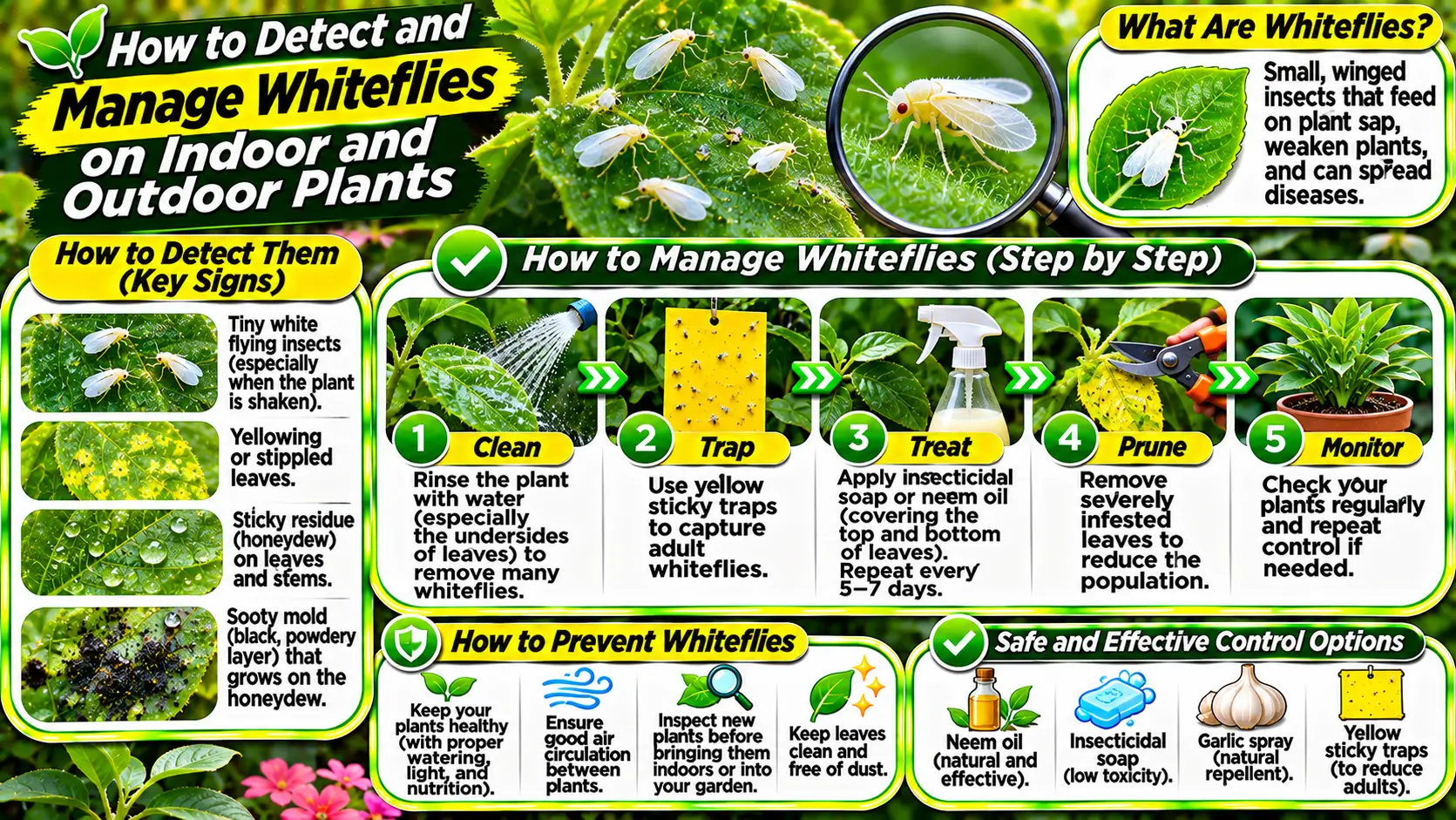
Whiteflies are small sap-feeding insects often found on the undersides of leaves. Despite their name, they are not true flies; they belong to the same broad insect order as aphids and scale insects. Adults are tiny, pale insects with powdery-looking wings. When a heavily infested plant is disturbed, adults may rise in a cloud and settle again nearby. Immature stages remain attached to leaves and are easier to overlook, so checking only for flying adults can underestimate the problem.
This guide helps readers detect and identify whiteflies on indoor and outdoor plants, including the signs left by adults and immature stages. Its main purpose is diagnosis and early recognition before selecting a control plan.
Table of Contents
- Typical symptoms
- How to inspect correctly
- Understanding the life cycle
- Isolating and reducing spread
- Physical and cultural controls
- Using soaps and oils responsibly
- Encouraging natural enemies
- Why repeat monitoring is essential
- Preventing whitefly problems
- When to seek additional help
- A balanced approach
- Match whitefly control to the life stage present
- Frequently Asked Questions
Typical symptoms
Whitefly feeding can cause leaves to become pale, yellow, weak, or prematurely shed. Both adults and immature stages remove plant sap, and heavy populations can reduce vigor and yield. Some species excrete honeydew, which leaves foliage sticky and may support sooty mold. The dark coating can interfere with photosynthesis and make plants look dirty. Symptoms are not unique to whiteflies, so inspect the undersides of affected leaves before deciding that the insects are responsible.
How to inspect correctly
Choose several leaves from different parts of the plant, including older leaves and fresh growth. Turn them over and look for tiny white adults, flat oval immature insects, and small pale eggs arranged in groups or arcs. Tap a branch gently over a sheet of white paper to see whether adults fly up. A hand lens makes immature stages easier to recognize. Inspect neighboring plants and weeds, because whiteflies can move between hosts and reinfest a treated plant.
Understanding the life cycle
Whiteflies develop through egg, immature, and adult stages. Eggs are usually attached to leaf tissue, while the immature stages feed in place. Warm conditions can allow generations to overlap, meaning eggs, nymphs, and adults may all be present at once. This explains why a single treatment may reduce visible adults without eliminating the population. Effective management needs repeated monitoring and methods that reach the stages present on the plant.
Isolating and reducing spread
Move affected houseplants away from healthy specimens if possible. Avoid carrying infested leaves through the growing area, and remove badly affected foliage when the plant can tolerate pruning. Bag and dispose of removed material rather than composting it beside susceptible plants. Wash hands and clean tools after handling an infested plant. Outdoors, remove heavily infested weeds and plant residues where appropriate, while avoiding unnecessary removal of habitat that supports beneficial insects.
Physical and cultural controls
A firm but gentle stream of water can dislodge some adults and immature insects from sturdy plants. Repeat as needed, concentrating on leaf undersides without breaking stems or washing soil from containers. Yellow sticky cards can help detect adult activity and capture some flying insects, but they do not control eggs or attached immature stages by themselves. Keep plants appropriately spaced, remove weeds that serve as hosts, and avoid excessive nitrogen that produces tender growth.
Using soaps and oils responsibly
Insecticidal soaps and horticultural oils may help manage whiteflies when they directly contact susceptible stages. Coverage of leaf undersides is particularly important. Use only products labeled for the plant and intended setting, follow all directions, and test a small area before treating the entire plant. Some species are sensitive to oils, heat, or soap residues. Avoid treating drought-stressed plants or applying products during intense heat unless the label permits it. Never mix products unless the label specifically instructs you to do so.
Encouraging natural enemies
Parasitic wasps, lady beetles, lacewings, and predatory bugs can contribute to whitefly suppression. In outdoor gardens, conserving these organisms often makes management more sustainable. Avoid broad-spectrum sprays that remove natural enemies along with pests. Some biological control organisms are sold for greenhouse use, but they require correct identification, suitable temperatures, and careful release timing. If you manage a greenhouse, consult a local extension service or biological-control supplier before selecting a species.
Why repeat monitoring is essential
Check plants every few days after taking action, paying special attention to new leaves and the undersides of older foliage. Sticky cards can show whether adult activity is increasing or decreasing, but use direct leaf inspection to assess immature stages. Continue checks after adults become less visible, because a new generation may emerge from eggs or immature insects that escaped the first treatment. Keep a simple record of dates, affected plants, and observations to identify patterns.
Preventing whitefly problems
Inspect all incoming plants before placing them in a greenhouse, garden bed, or indoor collection. Quarantine new purchases for a short observation period and check leaf undersides repeatedly. Keep weeds under control, remove plant debris, and maintain suitable growing conditions. Avoid overfertilizing, and water according to plant needs rather than allowing repeated stress. Where whiteflies are a recurring outdoor issue, choose locally suitable plant varieties and avoid placing susceptible plants directly beside known host plants.
When to seek additional help
Persistent infestations may involve a whitefly species that is difficult to manage or a plant virus transmitted by certain whiteflies. If plants show unusual distortion, mottling, or decline beyond ordinary sap-feeding symptoms, obtain a reliable diagnosis. Local agricultural extension services can help identify pests and recommend controls registered for the region. Do not assume that a product suitable for one crop or country is appropriate for another. Always follow local regulations and the product label.
A balanced approach
Whitefly management is most effective when several compatible measures are combined. Identify the pest, isolate affected plants, reduce heavily infested material, use physical controls, protect natural enemies, and apply labeled products only when needed. Repeated inspection is more valuable than relying on one dramatic treatment. A steady routine prevents small populations from becoming severe outbreaks and helps protect pollinators, beneficial insects, and the long-term health of the growing environment.
A useful habit is to inspect plants at the same time each week and compare the newest growth with earlier observations. Consistency makes subtle changes easier to notice and reduces the chance that a problem will be mistaken for normal aging. Keep notes about the plant, location, symptoms, weather, watering, and any intervention. These details help identify patterns and make it easier to judge whether the approach is working.
Avoid treating a plant solely because a symptom resembles a photograph or a description online. Several pests, diseases, and environmental problems can produce similar signs. Examine the affected tissue closely, consider the recent growing conditions, and seek a reliable diagnosis when the plant is valuable or the problem is spreading. Correct identification saves time and helps prevent unnecessary pesticide use.
Always adapt care to the plant species and local conditions. A method suitable for a tough outdoor shrub may injure a delicate tropical houseplant or a young seedling. Read product labels completely, observe protective equipment and re-entry instructions, and follow local regulations. More product or more frequent treatment does not necessarily mean better control; careful timing and coverage are more important.
When several plants are affected, work from healthy plants toward affected ones and clean tools between groups. Keep new plants separate until they have been inspected, and avoid sharing unclean pots, trays, soil, or cuttings. These simple precautions reduce the movement of pests and pathogens through a collection and make it easier to contain a localized problem before it becomes widespread.
Recovery is often gradual. Existing scars, dead tissue, and old lesions may remain after the cause has been controlled, so evaluate the plant by the condition of new growth and whether fresh symptoms continue to appear. Maintain suitable light, water, nutrition, and spacing while the plant recovers. Avoid heavy pruning or fertilizing as an immediate response unless the plant’s needs clearly justify it.
Whitefly detection and control options
| Method | What it helps with | Limitation |
|---|---|---|
| Inspect leaf undersides | Find eggs, nymphs, and adults | Requires repeated checks |
| Yellow sticky cards | Monitor adult activity | Do not control immature stages on leaves |
| Prune heavily infested leaves | Reduce local pest numbers | Avoid removing too much healthy foliage |
| Water spray | Dislodge some insects | May need repeating and can spread disease if foliage stays wet |
| Natural enemies | Support biological control | Must suit the plant and environment |
| Follow-up monitoring | Detect reinfestation | Essential because life stages overlap |
For additional expert recommendations, see University of Minnesota Extension guidance on whiteflies.
Related guides:
- How to Identify and Control Thrips on Garden and Houseplants
- How to Identify and Control Scale Insects on Garden and Houseplants
Further plant health guides:
- Bacterial Leaf Spot: Symptoms, Causes, and Plant Care
- Damping-Off in Seedlings: Disease Causes, Symptoms, and Early Response
Match whitefly control to the life stage present
Turn over several leaves from different parts of the plant and look for eggs, flattened immature stages, and adults. Adults often fly up when foliage is disturbed, but the immatures remain attached to the undersides of leaves. This distinction matters: a treatment that knocks down flying adults may leave much of the developing population untouched. Record which stage is most common and whether new leaves are becoming colonized.
| What inspection shows | Interpretation | Management implication |
|---|---|---|
| Many adults, few settled immatures | Recent arrival or dispersal may be occurring | Inspect nearby host plants and monitor new leaf undersides |
| Numerous attached nymphs | A generation is developing on the plant | Do not rely on adult knockdown alone |
| Honeydew and sooty mold | Feeding has likely been occurring for some time | Check the extent of infestation and protect beneficials |
| Parasitized or darkened scales on leaves | Natural enemies may already be active | Assess live stages before choosing an intervention |
In greenhouses, weekly leaf inspections and dated sticky-card counts can reveal trends; UConn Extension advises inspecting the life stages present because eggs and pupae may tolerate treatments that affect adults or younger nymphs. Its whitefly management guidance also describes biological control options. For outdoor gardens, interpret observations in the context of weather, plant species, and nearby host weeds. Avoid spraying simply because adults are visible: confirm that populations are increasing and that the chosen product is labeled for the plant and pest.
Related Gardening Guides
Explore these related guides for more practical ideas and plant-care advice:
- How to Prevent and Manage Whiteflies in the Garden
- How to Identify and Control Thrips on Garden and Houseplants
- How to Identify and Control Scale Insects on Garden and Houseplants
Frequently Asked Questions
Where do whiteflies hide on plants?
Eggs and immature stages are usually found on leaf undersides, while adults may fly up when foliage is disturbed. Inspect several leaves at different heights rather than checking only the top surface.
Can whiteflies spread plant viruses?
Some whitefly species transmit plant viruses. The risk depends on the species and host plant, so identify the insect and monitor susceptible crops carefully.
Are sticky traps enough to manage whiteflies?
They can help monitor adult activity and catch some flying insects, but they do not remove immature stages attached to leaves. Use them as one part of an integrated plan.
How do I reduce whiteflies without harming beneficial insects?
Start with accurate identification, regular monitoring, removal of heavily infested material when appropriate, and methods that target the pest while limiting effects on beneficial organisms. Follow local guidance for any treatment.


5 thoughts on “How to Detect and Manage Whiteflies on Indoor and Outdoor Plants”