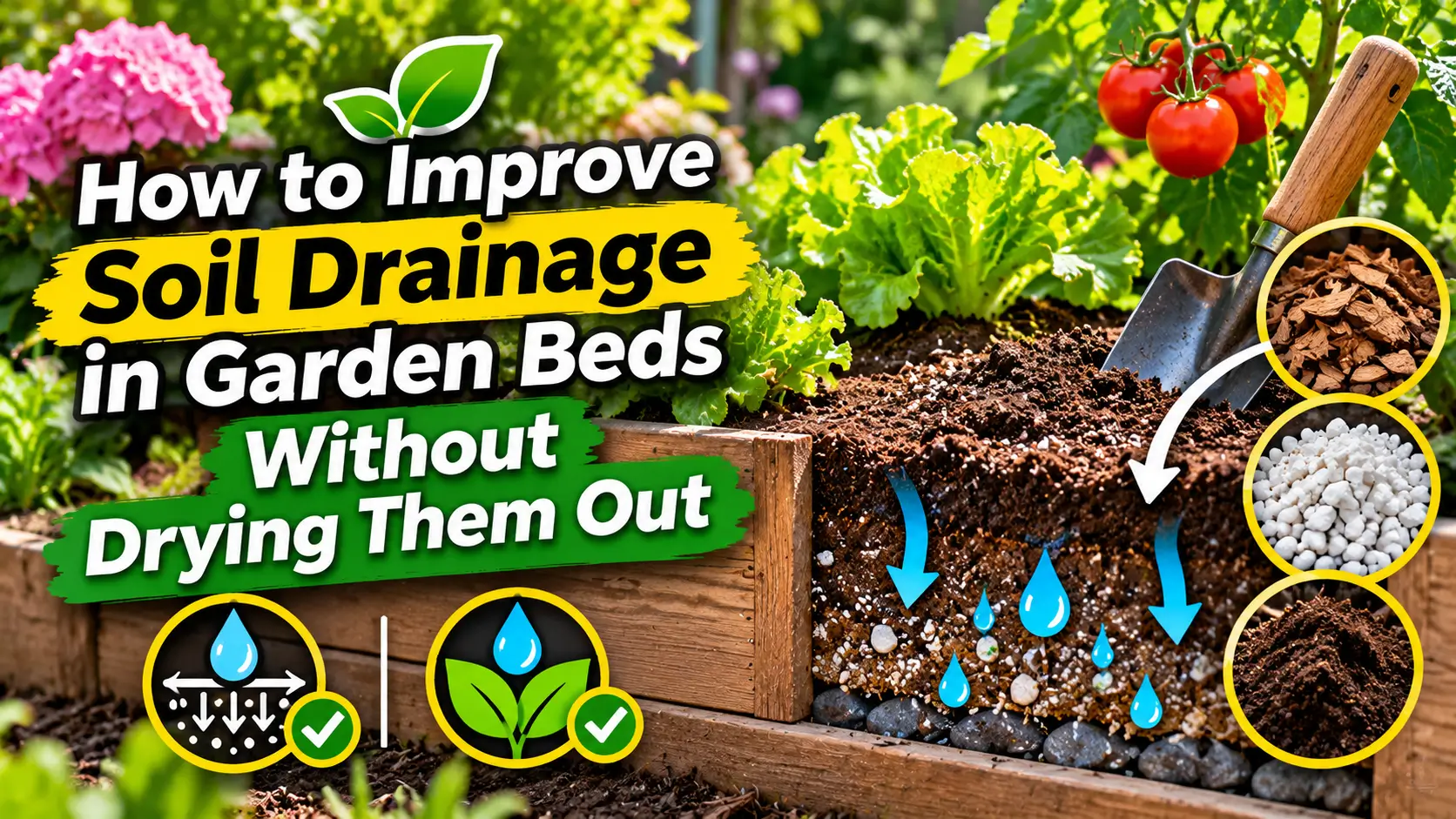
Healthy roots need both water and oxygen. When soil remains saturated for too long, air spaces fill with water and roots may struggle to function. Plants can show yellowing, weak growth, leaf drop, or symptoms that resemble nutrient deficiency. Poor drainage also favors several root and crown diseases. The goal is not to make every soil drain as quickly as possible, but to create a root environment that holds enough moisture while allowing excess water to move away.
Table of Contents
- Recognizing drainage problems
- Understanding the cause
- Testing infiltration
- Improving structure with organic matter
- Avoiding the sand mistake
- Using raised beds
- Managing surface runoff
- Reducing compaction
- Choosing suitable plants
- Watering after improvements
- A long-term drainage plan
- Separate surface runoff from slow soil drainage
- Use a repeatable infiltration check
- Match the remedy to the cause
- Frequently Asked Questions
Recognizing drainage problems
Observe the bed after ordinary rainfall or irrigation. Water that remains on the surface for many hours, persistently soggy soil, algae growth, and a sour smell can indicate poor drainage. Dig a small inspection hole and check whether the soil is saturated below the surface. Plants that wilt even when the ground is wet may have damaged roots rather than a lack of water. Compare problem areas with nearby healthy areas to identify differences in slope, soil texture, and compaction.
Understanding the cause
Poor drainage may result from heavy clay, compacted soil, a hardpan layer, a high water table, blocked outlets, or a low-lying position that collects runoff. These causes require different solutions. Adding compost can improve structure over time, but it will not correct a high water table or a blocked drainage outlet. Before changing the soil, determine where water comes from and where it can safely go.
Testing infiltration
A simple infiltration observation can help compare areas. Dig a hole of consistent size, moisten the soil first if it is extremely dry, then add water and observe how quickly it drains. This is not a professional drainage assessment, but it can reveal obvious differences. Avoid testing immediately after unusual storms or in a location disturbed by recent digging. For major landscape or construction-related drainage problems, consult a qualified local professional.
Improving structure with organic matter
Mature compost and suitable leaf mold can help improve aggregation and biological activity, particularly in soils with low organic matter. Apply a moderate layer and incorporate it into the surface where appropriate, or use it as a top dressing and allow soil organisms to work it in. Repeated modest additions are often more effective than one excessive application. Do not use fresh manure or unknown fill material as a quick fix.
Avoiding the sand mistake
Adding a small amount of sand to heavy clay is not a reliable way to improve drainage. Depending on proportions and material, the mixture can become dense and difficult to work. Structural improvement generally relies on organic matter, avoiding compaction, and selecting a suitable planting design. If a soil is extremely heavy, raised beds or planting species adapted to clay may be more practical than attempting to change the entire soil profile.
Using raised beds
Raised beds can help where the existing ground drains poorly, provided the bed is built with suitable material and has somewhere for excess water to move. A raised bed should not simply sit in a sealed container over saturated soil unless it is designed for that situation. Choose a growing medium with balanced water retention and aeration, and avoid filling the bed with pure compost. Consider access, bed height, and the mature root depth of the plants.
Managing surface runoff
Observe how rainwater moves across the garden. Roof downspouts, paved surfaces, and sloped lawns can direct large amounts of water into planting beds. Redirecting runoff to a safe, permitted area or using a rain garden may reduce saturation. Do not divert water onto neighboring properties, foundations, or public paths. Keep drains and channels clear of leaves and sediment, and ensure any drainage work follows local requirements.
Reducing compaction
Walking, wheelbarrows, and machinery can compress wet soil and reduce the pores that allow air and water movement. Keep regular foot traffic on paths and avoid working beds when they are saturated. Use designated beds and minimize unnecessary digging. Where compaction is shallow, careful loosening when soil is appropriately moist may help, but deep or widespread compaction may need a more considered approach.
Choosing suitable plants
Some plants tolerate moist soil better than others. If the site remains naturally wet and drainage improvements are limited, select species suited to those conditions rather than repeatedly replacing plants that need drier roots. Check the mature size and local suitability of any moisture-tolerant species, and avoid plants known to become invasive in your region. Plant selection is often the simplest long-term response to a site limitation.
Watering after improvements
Once drainage is improved, reassess irrigation. Soil that previously stayed wet may begin drying at a different rate after structural changes or raised-bed construction. Check moisture below the surface before watering and adjust frequency to the plants, weather, and soil. Do not continue an old schedule automatically. Mulch can reduce evaporation, but keep it away from stems and crowns that are sensitive to persistent moisture.
A long-term drainage plan
Effective drainage management starts with identifying the cause, observing water movement, and making targeted changes. Improve soil structure gradually, reduce compaction, manage runoff, and consider raised beds or moisture-tolerant plants when appropriate. Retest problem areas after normal rainfall and keep notes about how quickly they dry. The best solution maintains a balance: enough water for roots, but enough air and drainage to prevent prolonged saturation.
Before applying an amendment or changing a soil practice, identify the condition you are trying to improve. Similar symptoms can have different causes, and a product that helps one soil may be unnecessary in another. Use observation and, where appropriate, a laboratory test to guide decisions. Avoid making several major changes at once, because it becomes difficult to tell which one produced the result.
Choose materials from reliable sources and read labels carefully. Composition, maturity, nutrient content, and application instructions can vary considerably between products. Do not assume that a material is safe simply because it is described as natural or organic. Keep records of the product, rate, date, and area treated, and follow any local restrictions that apply to gardens and food crops.
Healthy soil management is cumulative. Protect the surface, maintain suitable organic matter, avoid compaction, and water according to the root zone rather than a fixed calendar. These habits support soil structure and make it easier to manage nutrients. They are not instant fixes, but consistent practice is usually more sustainable than repeated attempts to correct symptoms with large quantities of amendments.
Consider the needs of the plants that will grow in the area. A vegetable bed, ornamental border, lawn, and container planting may require different approaches. Match amendments and practices to the crop, climate, drainage, and soil conditions. When a problem is severe or persistent, seek local horticultural or soil advice instead of repeating a treatment without confirming the diagnosis.
Review results over a full growing period. Note how soil behaves after rain, how quickly it dries, and whether plant growth improves. Retest when recommended, especially after significant amendments. A gradual plan allows you to adjust rates and timing while reducing waste, nutrient runoff, and avoidable stress to plants.
Before adding amendments, identify whether the problem comes from compaction, soil structure, or the site’s drainage pattern; a soil test and simple infiltration observations can guide the next step. See University of Minnesota Extension’s soil-testing and infiltration guidance for practical guidance.
Diagnosing poor garden drainage
| Observation | Possible cause | Practical response |
|---|---|---|
| Water remains on surface | Compaction or low-lying grade | Check soil structure and surface flow |
| Soil stays saturated | Slow permeability or high water table | Consider raised beds or professional assessment |
| Runoff erodes beds | Uncontrolled slope flow | Use ground cover and safe water diversion |
| Containers remain wet | Blocked or insufficient drainage holes | Clear holes and use a suitable growing medium |
| Plants wilt in wet soil | Roots may lack oxygen or be damaged | Check roots and correct the moisture problem |
Separate surface runoff from slow soil drainage
Water remaining on the surface may come from a low spot, compacted topsoil, a blocked outlet, or runoff entering from a roof, slope, or paved area. Water that disappears from the surface but leaves the root zone saturated suggests a different problem below ground. Observe the bed during and after rainfall: note where water enters, where it collects, and how long the soil stays wet. A puddle alone does not identify the cause.
Use a repeatable infiltration check
- Compare several representative spots rather than testing only the wettest corner.
- Use the same hole dimensions and water volume at each location, and record the time water takes to enter after the soil has been pre-moistened.
- Repeat under similar conditions; very dry soil, cracks, recent cultivation, and different textures can distort a one-time result.
- Treat this as a screening observation, not a professional drainage assessment for severe or persistent waterlogging.
Match the remedy to the cause
| Likely cause | Clue | More suitable response |
|---|---|---|
| Surface runoff | Water enters from a slope, roof, or hard surface | Redirect runoff safely and correct grading |
| Surface compaction | Repeated foot or equipment traffic | Keep traffic off wet soil and loosen when conditions are suitable |
| Restrictive subsoil | Water accumulates above a dense layer | Identify its depth and extent before deep cultivation or drainage work |
| High water table | Bed stays saturated without surface inflow | Consider raised beds, suitable plants, or professional advice |
| Textural interface | Imported soil or amendments form a distinct layer | Assess the profile; avoid abrupt layers that impede water movement |
Do not try to fix clay by adding a small amount of sand; a poorly designed mixture can become dense. Organic matter can support structure over time, but it will not remove a high water table or deep impermeable layer. Colorado State University Extension emphasizes identifying the restrictive layer and underlying material before selecting a drainage treatment.
Reference: Colorado State University Extension: Soil Drainage.
Related Gardening Guides
Explore these related guides for more practical ideas and planning advice:
- How to Use Cover Crops to Protect and Improve Garden Soil
- How to Choose and Use Gypsum in Garden Soil
- How to Make and Use Homemade Compost Tea Responsibly
- How to Landscape a Sloped Garden: Terraces, Planting, and Drainage
- How to Design a Garden Layout That Is Both Beautiful and Practical
Frequently Asked Questions
How can I tell if a garden bed has poor drainage?
Look for water that remains pooled long after rain, persistently saturated soil, unpleasant odors, and plants showing stress despite adequate care. Compare several areas because compaction and soil layers can vary across a bed.
Does adding sand always improve clay soil drainage?
No. Small amounts of sand mixed into clay can make the structure worse. Improving soil organic matter, reducing compaction, and addressing the underlying water flow are usually more appropriate starting points.
Should I add a raised bed if the soil drains poorly?
A raised bed can help where the site has persistent drainage limitations, but it needs suitable soil, stable construction, and a plan for excess water. First identify whether the problem is compaction, a high water table, or runoff.
Can mulch solve waterlogged soil?
Mulch can protect the surface and support soil structure over time, but it will not fix a saturated subsoil or blocked drainage. Diagnose the cause before relying on surface treatments.

10 thoughts on “How to Improve Soil Drainage in Garden Beds Without Drying Them Out”